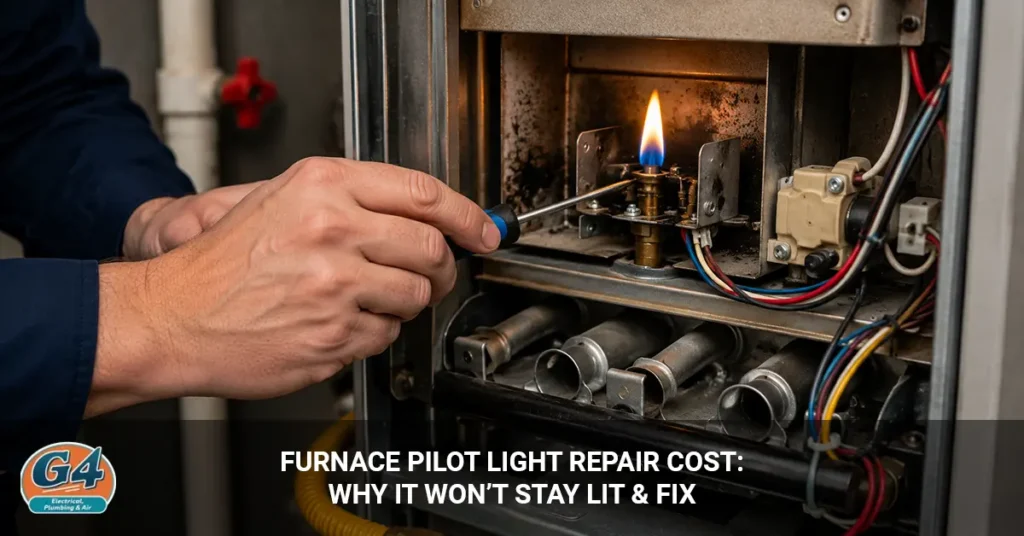
A furnace control board repair or replacement typically costs about $300 to $900, depending on the furnace model, board type, labor, and diagnostic fees. Some repairs cost less, while specialty OEM boards and difficult installations can push the price higher.
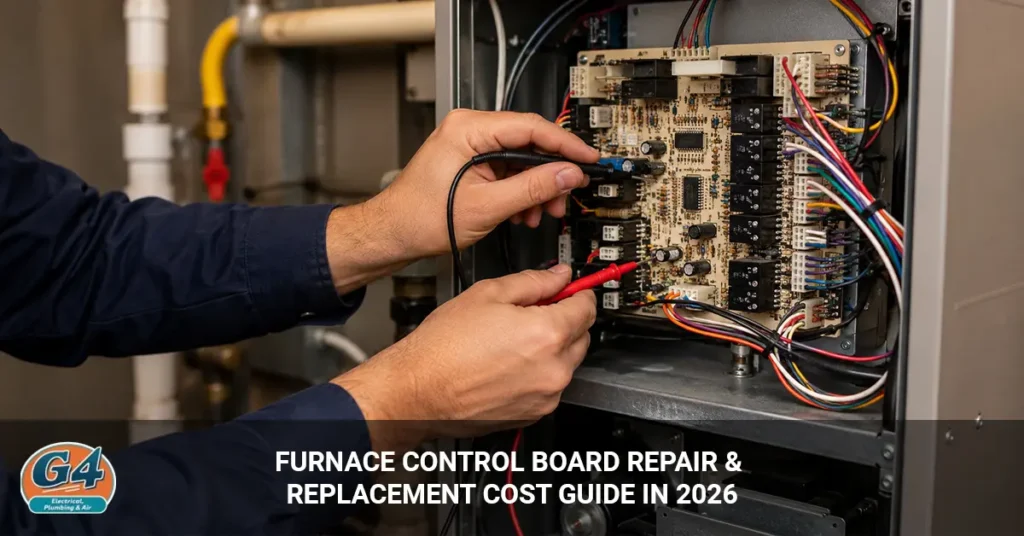
The control board is essentially the furnace’s central control system. It coordinates important operations such as the thermostat signal, ignition sequence, blower motor, safety controls, and other components.
When the board starts failing, the furnace can behave unpredictably. It may not start, shut down during a heating cycle, run the blower continuously, or stop responding to the thermostat.
The tricky part is that these symptoms don’t automatically mean the control board is bad. A thermostat, wiring problem, safety switch, or another furnace component can cause similar issues. Proper diagnosis can help you avoid replacing an expensive part unnecessarily.
How Much Does Furnace Control Board Repair Cost?
Furnace control board repair or replacement usually costs about $300 to $900, including the part and professional labor. The exact price depends on the board, furnace model, labor rates, and whether additional repairs are needed.
Here’s a general breakdown:
| Cost | Typical Range |
| Control board | 100–600 |
| Labor | 150–400 |
| Diagnostic/service fee | Varies |
| Total replacement | 300–900 |
| Emergency service | Can cost more |
These are general U.S. price ranges. Your actual cost can vary significantly based on your furnace and local HVAC rates.
The control board itself is often the most expensive part of the repair. Some furnaces use relatively inexpensive universal boards, while others require a specific OEM board.
Furnace Control Board Replacement Cost
A replacement furnace control board commonly costs $100 to $600 for the part alone. OEM boards for certain furnace brands and models can cost considerably more than universal replacements.
The technician must match the replacement board to your furnace. Using the wrong board can cause operating problems or damage other components.
The furnace’s model and serial number are usually needed to identify the correct replacement.
Furnace Control Board Repair Cost
Repairing a furnace control board can cost less than replacing it, but many HVAC companies recommend replacement when the board has a confirmed failure.
Some boards can be repaired at the component level. However, that requires specialized electronics knowledge and isn’t practical for every furnace.
A replacement board also gives the technician a known-good component with manufacturer specifications that match the furnace.
If the board is still under warranty, check the warranty before paying for a replacement.
What Makes Furnace Control Board Replacement More Expensive?
The biggest factors are the board type, furnace model, labor rate, accessibility, and whether another problem caused the board to fail.
You may pay more when:
- Your furnace requires an OEM control board.
- The board is difficult to source.
- The furnace is difficult to access.
- You need emergency service.
- The technician needs extensive diagnostic testing.
- Wiring needs to be repaired.
- Another electrical component has failed.
- The original board failure damaged another component.
If a new board fails shortly after installation, the technician should look for the underlying cause instead of simply installing another board.
Signs Your Furnace Control Board Is Failing
Common signs of a failing furnace control board include a furnace that won’t start, random shutdowns, continuous blower operation, thermostat communication problems, and unusual diagnostic lights.
These symptoms don’t prove that the control board has failed. Other furnace components can create the same symptoms. Learn more about common furnace repair signs before assuming the control board is the problem.
Furnace Won’t Turn On
If your furnace won’t turn on when the thermostat calls for heat, the control board could be involved, but power, wiring, and thermostat problems should also be checked.
The control board receives the heating signal and coordinates the furnace’s startup sequence.
If the board can’t process that signal correctly, the furnace may not begin its normal operation.
Before blaming the control board, a technician should verify that the furnace has power and that the thermostat is communicating correctly.
Furnace Starts but Won’t Complete the Heating Cycle
A furnace that starts but doesn’t complete its normal heating sequence may have a control-board problem, but another failed component could also interrupt the cycle.
The control board coordinates several stages of furnace operation.
If a safety switch detects a problem, for example, the board may shut down the furnace as designed. That doesn’t mean the board itself is defective.
This is why understanding the furnace’s sequence of operation is important when diagnosing a control-board problem.
Furnace Blower Runs Continuously
A blower that runs continuously can be caused by a faulty control board, but thermostat settings, wiring, and other furnace problems can produce the same symptom.
The control board controls when the blower starts and stops.
If the board’s blower relay becomes stuck, the blower may continue running even when there is no active heating cycle.
However, continuous blower operation isn’t enough by itself to justify replacing the board.
Furnace Turns On and Off Randomly
Random furnace shutdowns can be a sign of a control-board problem, but they are more often a symptom that requires further diagnosis.
A furnace can shut down because of a safety switch, overheating, airflow restriction, flame-sensing problem, ignition failure, or another issue.
The control board may simply be responding to one of these conditions.
Furnace Doesn’t Respond to the Thermostat
If the thermostat calls for heat but the furnace doesn’t respond, the control board is one possible cause, but the thermostat and low-voltage wiring should be checked first.
A faulty thermostat or damaged wire can prevent the heating signal from reaching the control board.
Replacing the board won’t solve that problem.
Furnace Shows an Error Code or Diagnostic Light
A flashing diagnostic light can point to a furnace problem, but an error code does not automatically mean the control board has failed.
Many furnaces use LED lights on the control board to communicate fault codes.
The exact meaning depends on the furnace manufacturer and model.
Check the furnace’s documentation for the correct code before assuming the board itself is defective.
Visible Damage or Burn Marks on the Control Board
Burn marks, corrosion, melted components, or obvious physical damage can indicate a damaged control board and should be inspected by a professional.
A damaged board may have been affected by an electrical surge, moisture, overheating, a short circuit, or another furnace problem.
If the board is visibly damaged, don’t attempt to repair it while the furnace is powered.
What Causes a Furnace Control Board to Fail?
Furnace control boards can fail because of electrical surges, voltage problems, moisture, overheating, wiring faults, short circuits, age, or damage from another failed component.
Electrical Surges
Power surges can damage sensitive electronic components on the control board.
A surge may come from the home’s electrical system or from an external event such as a lightning strike.
Voltage Problems
Incorrect or unstable voltage can damage electronic components and shorten the life of a control board.
If a board keeps failing, the electrical supply should be checked before another board is installed.
Moisture and Corrosion
Moisture can damage a furnace control board by causing corrosion or electrical shorts.
Water leaks, condensation, and high humidity around the furnace can create problems for electronic components.
Overheating
Excessive heat can contribute to control-board failure and shorten the life of electronic components.
A furnace that repeatedly overheats should be diagnosed instead of simply replacing the board.
Wiring Problems
Damaged, loose, or shorted wiring can cause control-board problems and may damage a replacement board.
This is another reason a technician should inspect the wiring when a board fails unexpectedly.
Age and Component Failure
Control boards can eventually fail as their electronic components wear out over time.
Age alone doesn’t mean a board needs replacement. If the furnace is operating normally and the board has no confirmed fault, replacing it as preventive maintenance usually isn’t necessary.
Can a Furnace Control Board Be Repaired?
Some furnace control boards can be repaired, but replacement is often the more practical option when the board has a confirmed failure.
A board may contain individual components such as relays, capacitors, resistors, or other electronic parts that can technically be replaced.
However, component-level repair requires specialized knowledge and equipment.
Many HVAC technicians replace the entire board because it is faster, more reliable, and easier to warranty than repairing individual electronic components.
If you’re considering board repair, ask the technician whether the board is repairable and whether a replacement is available.
How Long Does a Furnace Control Board Last?
A furnace control board can last many years, but its lifespan depends on electrical conditions, furnace operation, moisture, heat, and the quality of the board.
There isn’t one exact replacement interval for a control board.
If your furnace has operated reliably for years, there is usually no reason to replace the board simply because it is old.
Repeated failures are different. If multiple boards fail within a short period, something else may be damaging them.
How Long Does Furnace Control Board Replacement Take?
A straightforward furnace control board replacement can often be completed in about one to two hours, including testing, once the correct board is available.
The service can take longer if:
- The board is difficult to access.
- The correct replacement isn’t in stock.
- Wiring needs repair.
- Another component has failed.
- The technician needs additional diagnostic testing.
- The replacement board requires configuration or setup.
Diagnosis can also take time because the technician needs to determine whether the board is actually responsible for the furnace problem.
Furnace Control Board vs. Thermostat: What’s the Difference?
The thermostat tells the furnace when to heat, while the control board receives that signal and coordinates the furnace’s operation.
| Component | Main Job | Common Problem |
| Thermostat | Calls for heating | Furnace doesn’t respond to temperature setting |
| Control board | Coordinates furnace operation | Multiple functions behave incorrectly |
A thermostat problem can look like a control-board failure.
For example, if the thermostat isn’t sending the correct signal, the furnace may not start even though the control board is working properly.
That’s why technicians normally check the thermostat, wiring, power supply, and other relevant components before replacing the control board.
Is It Worth Replacing a Furnace Control Board?
Replacing a failed control board is usually worth it when the furnace is otherwise in good condition, and the repair cost is reasonable compared with the furnace’s age and replacement cost.
A 300–900 repair can make sense for a furnace that still has years of useful life left.
The decision deserves more consideration when the furnace is older or has needed several expensive repairs. Before deciding whether to repair or replace the system, compare current furnace replacement costs with the expected repair expenses.
Consider the overall condition of the system if:
- The furnace is near the end of its expected service life.
- You’ve had several major repairs recently.
- Other expensive components are failing.
- The furnace has a significant safety issue.
- Repair costs are becoming frequent.
A failed control board by itself doesn’t automatically mean you need a new furnace.
Furnace Control Board Replacement Cost FAQs
How much does it cost to replace a furnace control board?
Furnace control board replacement typically costs about $300 to $900, including the part and professional labor. OEM boards, difficult installations, and emergency service can increase the total.
How do I know if my furnace control board is bad?
A furnace that won’t start, shuts down unexpectedly, runs the blower continuously, or behaves erratically may have a bad control board. These symptoms can also come from other components, so testing is needed to confirm the cause.
Can a furnace control board be repaired?
Some control boards can be repaired, but replacement is often more practical when the board has a confirmed failure. The best option depends on the board, furnace model, availability, and repair cost.
How long does a furnace control board last?
A control board can last many years, but there is no fixed replacement schedule. Electrical problems, moisture, overheating, and other furnace issues can shorten its life.
Why is my furnace blower running continuously?
A continuously running blower can be caused by a faulty control board, thermostat settings, wiring problems, or another furnace issue. The control board shouldn’t be replaced until the actual cause is confirmed.
Can a bad thermostat damage a furnace control board?
A thermostat or wiring problem can affect the control circuit, but it doesn’t automatically mean the control board has been damaged. Both should be tested when a furnace doesn’t respond properly to the thermostat.
How long does it take to replace a furnace control board?
A straightforward control board replacement can often take about one to two hours, including testing. The job can take longer if the board is difficult to access or another problem needs to be repaired.
Should I repair or replace my furnace if the control board fails?
You don’t usually need to replace the entire furnace because of a failed control board. If the furnace is otherwise in good condition, repairing the board or replacing it is often the better choice.
When Should You Call an HVAC Professional?
Call a professional for furnace repair when your furnace won’t start, behaves unpredictably, repeatedly shuts down, or shows signs of an electrical or control problem.
Get professional help if:
- The furnace won’t respond to the thermostat.
- The blower runs continuously.
- The furnace repeatedly shuts down.
- Diagnostic lights indicate a fault.
- You see burn marks or damage on the control board.
- The circuit breaker repeatedly trips.
- The control board has failed more than once.
- You’re unsure whether the board or another component is causing the problem.
Don’t replace the control board based on symptoms alone.
A proper diagnosis can determine whether the problem is actually the board, thermostat, wiring, ignition system, safety control, blower circuit, or another component.
Final Takeaway
Furnace control board repair or replacement typically costs about $300 to $900, depending on the board, furnace model, labor, and other repair requirements.
A furnace that won’t start, shuts down unexpectedly, runs the blower continuously, or behaves erratically may have a failing control board. But these symptoms can also come from other furnace components.
If the control board is confirmed to be faulty, replacement is usually a practical repair when the furnace is otherwise in good condition. Before spending hundreds of dollars on a new board, have the system properly diagnosed so you know the board is actually the source of the problem.