
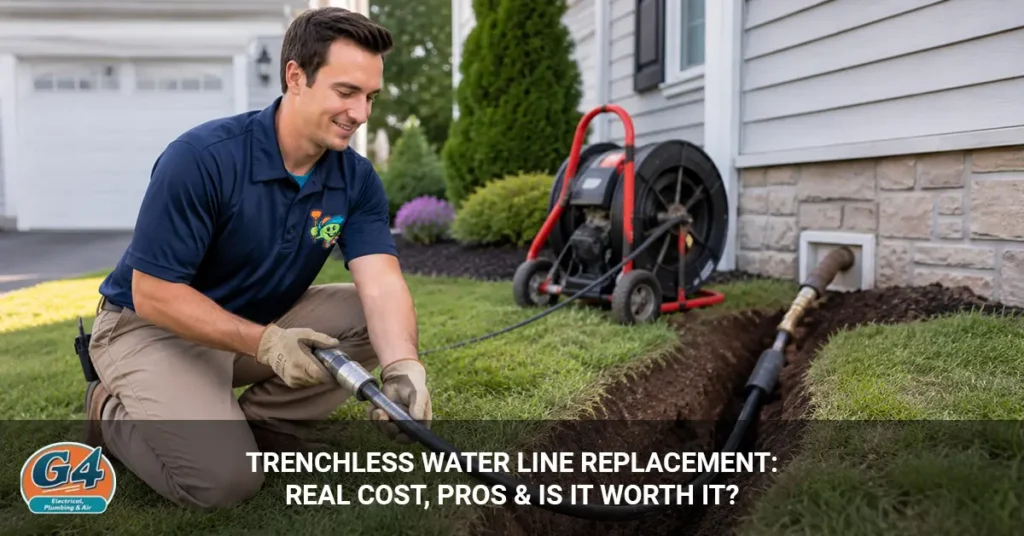
Trenchless water line replacement typically costs between $2,000 and $8,000, depending on the length of the water line, the installation method, soil conditions, and local labor rates. Although the upfront installation cost is often higher than traditional trenching, many homeowners spend less overall because trenchless replacement minimizes damage to lawns, driveways, sidewalks, patios, and landscaping.
If your main water line has frequent leaks, low water pressure, discolored water, or has reached the end of its service life, trenchless replacement may be a practical long-term solution. Instead of digging a trench across your entire yard, licensed plumbers use specialized equipment to install a new water line through one or two small access pits, reducing disruption while providing a durable replacement.
This guide explains how much trenchless water line replacement costs, what affects the price, how pipe bursting and directional boring work, the pros and cons of each approach, and when trenchless replacement is worth the investment. By the end, you’ll have the information you need to compare your options and decide whether trenchless water line replacement is the right choice for your home.
How Much Does Trenchless Water Line Replacement Cost?
Trenchless water line replacement typically costs between $2,000 and $8,000, although larger or more complex projects can cost more. The total price depends on the length and depth of the water line, the installation method, soil conditions, pipe material, and local labor rates.
While trenchless replacement often has a higher upfront installation cost than traditional trenching, it can reduce the overall project cost by minimizing damage to your property. Because there’s less excavation, homeowners often spend less repairing lawns, landscaping, driveways, patios, sidewalks, and irrigation systems after the work is complete.
The table below shows the average cost of common trenchless water line replacement services.
| Project | Average Cost |
| Pipe bursting | $2,500–$7,000 |
| Directional boring | $3,000–$8,000 |
| Spot excavation (if needed) | $500–$2,000 |
| Traditional trench replacement | $2,000–$6,500 |
| Landscaping restoration | $500–$5,000+ |
These are average price ranges. Your actual cost will depend on your property’s layout, the condition of the existing water line, and the complexity of the installation.
What Affects Trenchless Water Line Replacement Cost?
The cost of trenchless water line replacement depends on the complexity of the project, the installation method, and your property’s conditions. Two homes with similar water line problems can have very different replacement costs because every installation presents unique challenges.
Several factors influence the final price:
- Length of the water line: Longer service lines require more pipe, labor, and installation time, increasing the total project cost.
- Replacement method: Pipe bursting and directional boring use different equipment and installation techniques, so pricing varies depending on which method is suitable for your property.
- Pipe material: Most contractors install HDPE (high-density polyethylene) or PEX water lines because they resist corrosion and provide a long service life. Material costs vary based on the pipe size and type selected.
- Depth of the existing water line: Deeper water lines require additional labor and specialized equipment, which can increase installation costs.
- Soil conditions: Rocky ground, heavy clay, and tree roots can make drilling more difficult and extend the installation time.
- Property accessibility: Limited access, steep slopes, fences, retaining walls, or other obstacles may require additional labor or specialized equipment.
- Permits and inspections: Many cities and municipalities require permits and inspections for water service line replacement, adding to the total project cost.
- Local labor rates: Installation costs vary by region based on labor availability and the experience of local trenchless plumbing contractors.
- Emergency replacement: If your water line fails unexpectedly, after-hours or emergency service may increase labor costs.
Most trenchless projects also require underground utility locating before work begins to help prevent damage to gas, electrical, communication, or sewer lines. Depending on your location, permit fees, inspection costs, and utility locating may be included in the contractor’s estimate or billed separately.
The most accurate way to determine your replacement cost is to schedule an on-site inspection. A licensed plumber can assess the condition of your existing water line, determine whether trenchless replacement is feasible, recommend the most appropriate installation method, and provide a detailed estimate based on your property’s specific conditions.
What Is Trenchless Water Line Replacement?
Trenchless water line replacement is a method of replacing an underground water service line with minimal excavation. Instead of digging a trench across your entire yard, plumbers create one or two small access pits and use specialized equipment to install a new water line underground. This approach significantly reduces damage to lawns, landscaping, driveways, sidewalks, patios, and other outdoor features.
Unlike traditional water line replacement, which requires excavating the entire length of the pipe, trenchless installation preserves most of your property while still providing a durable, long-lasting solution. In many cases, homeowners choose trenchless replacement because it reduces cleanup, shortens the project timeline, and minimizes the cost of restoring landscaping and hardscaping after the work is complete.
Most trenchless water line replacement projects are completed within one to two days, although the exact timeline depends on the length and depth of the water line, soil conditions, property accessibility, and the installation method used.
Trenchless replacement is often the preferred option for homes with mature landscaping, concrete driveways, decorative walkways, or other features that would be expensive or time-consuming to remove and restore. However, it’s not the right solution for every property. Factors such as the condition of the existing water line, underground utilities, soil conditions, and local building requirements all affect whether trenchless installation is feasible.
Before recommending a replacement method, a licensed plumber will inspect the existing water line, locate underground utilities, evaluate site conditions, and determine whether trenchless replacement or traditional excavation is the better long-term solution for your property.
How Does Trenchless Water Line Replacement Work?
Trenchless water line replacement installs a new underground water line without digging a trench across your entire yard. Instead, plumbers use specialized equipment to replace or install the new pipe through one or two small access pits. The exact method depends on the condition of the existing water line, the property’s layout, and whether the new pipe can follow the same route.
The two most common trenchless replacement methods are pipe bursting and directional boring. Both minimize excavation, but they’re designed for different installation conditions.
Pipe Bursting
Pipe bursting replaces an existing water line by breaking apart the old pipe while pulling a new pipe into the same underground path. It’s one of the most common trenchless methods for replacing aging or damaged water service lines without excavating the entire yard.
To perform the replacement, plumbers dig a small access pit at each end of the existing water line. A hydraulic bursting head is then pulled through the old pipe, fracturing it outward while simultaneously pulling a new HDPE (high-density polyethylene) pipe into place. Because the new pipe follows the original route, only minimal excavation is required.
Pipe bursting is often the best choice when the existing water line is leaking, corroded, or has reached the end of its service life but still provides a usable path for the new pipe. It’s also a practical solution for properties with mature landscaping, driveways, patios, or sidewalks that homeowners want to preserve.
Benefits of Pipe Bursting
Pipe bursting offers several advantages over traditional excavation:
- Replaces the entire water line instead of repairing individual leaks.
- Requires only small access pits rather than a continuous trench.
- Minimizes damage to lawns, landscaping, driveways, and sidewalks.
- Installs a durable, corrosion-resistant HDPE water line designed to last for decades.
- Reduces cleanup and restoration work after the installation.
When Pipe Bursting Isn’t the Best Option
Pipe bursting isn’t suitable for every property. If the existing pipe has completely collapsed, the route needs to change, or underground utilities leave insufficient space for the bursting head, another replacement method may be more appropriate.
A licensed plumber will inspect the existing water line and surrounding site conditions before determining whether pipe bursting is the safest and most effective solution.
Directional Boring
Directional boring installs a new water line by drilling a controlled underground path instead of using the existing pipe. Unlike pipe bursting, this method creates an entirely new route, making it an excellent option when the existing water line has collapsed, needs to be relocated, or can’t be safely reused.
The process begins by drilling a small pilot hole between two access points. Once the correct path is established, the borehole is gradually enlarged to accommodate the new water line. The contractor then pulls the new pipe, typically HDPE (high-density polyethylene), through the completed bore path.
Because the drill head can be precisely guided underground, directional boring allows plumbers to route the new water line around obstacles such as tree roots, driveways, sidewalks, foundations, retaining walls, and underground utilities. This flexibility makes it one of the most versatile trenchless replacement methods.
When Directional Boring Is the Best Choice
Directional boring is often recommended when installing a new water line along a different route or when pipe bursting isn’t feasible. It’s commonly used when:
- The existing water line has collapsed or can’t be used as a guide.
- The new pipe needs to follow a different path.
- Large trees, driveways, patios, or other structures make traditional trenching impractical.
- Underground utilities require the new water line to be carefully routed around them.
Benefits of Directional Boring
Directional boring offers several advantages for homeowners:
- Installs a completely new water line without extensive excavation.
- Minimizes damage to lawns, landscaping, driveways, and sidewalks.
- Allows the contractor to avoid underground obstacles and utilities.
- Provides a durable, long-lasting water line with minimal disruption to the property.
When Directional Boring May Not Be the Best Option
Directional boring typically costs more than traditional excavation because it requires specialized drilling equipment and experienced operators. The project may also take longer if rocky soil, difficult ground conditions, or underground obstacles require adjustments to the drilling path.
A licensed plumber can determine whether directional boring or pipe bursting is the better option after evaluating your existing water line, soil conditions, property layout, and underground utilities.
Pipe Bursting vs. Directional Boring
Pipe bursting and directional boring are both effective trenchless water line replacement methods, but each is designed for different installation conditions. With pipe bursting, the existing water line is replaced along its current route. In contrast, directional boring installs a new water line along a newly drilled path. The best choice depends on the condition of the existing pipe, your property’s layout, and whether the new line needs to be relocated.
The table below highlights the main differences.
| Feature | Pipe Bursting | Directional Boring |
| Uses the existing pipe path | Yes | No |
| Requires the existing pipe | Yes | No |
| Can relocate the water line | No | Yes |
| Best for replacing damaged existing pipes | Yes | Sometimes |
| Ideal for avoiding underground obstacles | Limited | Excellent |
| Typical installation cost | Lower | Higher |
Which Method Is Better?
Neither method is better for every project because each solves a different problem. Pipe bursting is usually the better option when the existing water line can be replaced along the same route with minimal excavation. It’s often more cost-effective and works well when the old pipe still provides a usable path for the new one.
Directional boring is typically the better choice when the new water line needs to avoid obstacles or follow a different route. Because the drill head can be precisely guided underground, it’s often used to install water lines beneath driveways, sidewalks, mature trees, retaining walls, and other structures without extensive excavation.
The final decision depends on several factors, including the condition of the existing water line, soil conditions, underground utilities, property accessibility, and local building requirements. After inspecting your property, a licensed plumber can recommend the trenchless replacement method that provides the safest, most reliable, and most cost-effective long-term solution.
Trenchless vs. Traditional Water Line Replacement
The biggest difference between trenchless and traditional water line replacement is the amount of excavation required. Trenchless methods replace the water line through one or two small access pits, while traditional replacement requires digging a trench along the entire length of the pipe. Although trenchless installation usually costs more upfront, it often reduces the total project cost by minimizing property damage and restoration work.
The table below compares the two methods.
| Trenchless Replacement | Traditional Replacement |
| Requires minimal digging | Requires a full trench |
| Usually completed in 1–2 days | May take several days |
| Minimal damage to landscaping | Significant property disruption |
| Higher installation cost | Lower installation cost |
| Lower restoration costs | Higher restoration costs |
| Ideal for driveways, patios, and mature landscaping | Better for properties with easy excavation |
Which Option Is More Cost-Effective?
Traditional excavation usually has a lower installation cost, but trenchless replacement can provide better overall value. While trenchless methods require specialized equipment and skilled operators, they often eliminate the expense of rebuilding lawns, irrigation systems, driveways, sidewalks, patios, and landscaping after the work is complete. On properties with expensive hardscaping or mature trees, the savings on restoration can offset much of the higher installation cost.
Which Method Is Better for Your Property?
The best replacement method depends on your property’s layout and the condition of the existing water line. Trenchless replacement is often the better choice if the pipe runs beneath a driveway, sidewalk, patio, or mature landscaping that would be costly to remove and restore. Traditional excavation may be more practical when the water line is easy to access, the yard has few obstacles, or trenchless installation isn’t feasible because of soil conditions or utility conflicts.
Which Method Lasts Longer?
Both trenchless and traditional replacement provide a reliable, long-lasting water line when installed correctly. The lifespan depends more on the pipe material and the quality of the installation than on the replacement method itself. Modern HDPE and PEX water lines resist corrosion, leaks, and root intrusion, making them durable options that can provide reliable service for several decades.
A licensed plumber can inspect your property, compare both installation methods, and recommend the option that offers the best balance of cost, durability, and long-term value.
Pros and Cons of Trenchless Water Line Replacement
Trenchless water line replacement offers significant advantages, but it isn’t the right solution for every property. Understanding its benefits and limitations can help you decide whether it’s worth the higher upfront cost.
Pros
Minimal Excavation
Trenchless replacement requires only one or two small access pits instead of a full trench. This minimizes disruption to your yard and reduces the amount of cleanup required after the project is finished.
Protects Landscaping and Hardscaping
One of the biggest advantages of trenchless replacement is preserving your property. Because there’s very little digging, lawns, gardens, mature trees, driveways, patios, sidewalks, and retaining walls are far less likely to be damaged, reducing restoration costs.
Faster Installation
Most trenchless water line replacements are completed in one to two days. With less excavation, contractors spend less time digging, backfilling, and restoring the work area, allowing homeowners to return to normal more quickly.
Durable, Long-Lasting Pipe Materials
Modern trenchless systems typically use HDPE or PEX piping designed to provide decades of reliable service. These materials resist corrosion, mineral buildup, leaks, and many of the problems that affect older galvanized steel water lines.
Less Disruption During the Project
Trenchless installation allows you to keep most of your property usable while the work is underway. Because excavation is limited, there’s less noise, less mess, and fewer obstacles around your home compared with traditional trenching.
Cons
Higher Upfront Installation Cost
Trenchless replacement usually costs more to install than traditional excavation. Specialized equipment, advanced installation techniques, and experienced operators contribute to the higher initial price.
Not Suitable for Every Property
Some properties aren’t good candidates for trenchless replacement. Completely collapsed pipes, difficult soil conditions, underground utility conflicts, or limited access may require traditional excavation instead.
Requires Specialized Contractors
Not every plumbing company offers trenchless water line replacement. The work requires specialized equipment and technicians trained in pipe bursting or directional boring.
Some Excavation Is Still Required
Trenchless doesn’t mean completely dig-free. Contractors still need to excavate small access pits to install the new water line, although the amount of digging is far less than with traditional replacement.
Is Trenchless Water Line Replacement Worth It?
For many homeowners, trenchless water line replacement is worth the higher upfront cost because it minimizes property damage and can reduce the total cost of the project. While trenchless installation typically costs more than traditional excavation, the savings on restoring landscaping, driveways, patios, sidewalks, and irrigation systems often make it the better long-term investment.
Trenchless replacement is usually the best choice if your water line runs beneath mature landscaping, concrete driveways, decorative walkways, patios, or other outdoor features that would be expensive to remove and rebuild. It’s also a good option if you want to minimize disruption to your property or plan to stay in your home for many years.
Traditional excavation may be the more practical solution when the water line is short, easy to access, and can be replaced without damaging valuable landscaping or hardscaping. It may also be the better choice if trenchless installation isn’t feasible because of soil conditions, underground utilities, or property access, or if keeping the upfront installation cost as low as possible is your primary concern.
The most important comparison isn’t the installation price, it’s the total project cost. A lower installation estimate can become more expensive once you factor in the cost of repairing lawns, replacing irrigation systems, rebuilding driveways, or restoring landscaping after excavation.
Because every property is different, the best replacement method should be based on a professional inspection rather than cost alone. A licensed plumber can evaluate your existing water line, determine whether trenchless replacement is feasible, and compare the total cost, expected lifespan, and long-term value of both trenchless and traditional installation methods before you make a decision.
Signs You May Need a Water Line Replacement
Frequent leaks, low water pressure, discolored water, and unusually high water bills are common signs that your main water line may need to be replaced. While some water line problems can be repaired, recurring issues often indicate the pipe has reached the end of its service life, and that replacement may be the more cost-effective long-term solution.
If you notice any of the following warning signs, schedule a professional inspection before the problem becomes more expensive to fix.
Low Water Pressure Throughout Your Home
A noticeable drop in water pressure throughout your home can indicate a damaged or deteriorating water line. Cracks, corrosion, mineral buildup, or underground leaks can restrict water flow before the problem becomes visible. If every faucet and shower has weak pressure, the main water line should be inspected.
While a failing water service line is one possible cause, low water pressure can also result from pipe corrosion, plumbing leaks, mineral buildup, or pressure regulator problems that require professional diagnosis.
Discolored or Rust-Colored Water
Brown, yellow, or rusty water often indicates corrosion inside an aging water line. Older galvanized steel pipes are especially susceptible to rust, which can affect water quality and reduce water flow. If the discoloration doesn’t clear after running the tap for several minutes, it’s time to have the water line evaluated.
Unexplained Increase in Your Water Bill
A sudden increase in your water bill without higher water usage often points to a hidden leak. Learning to recognize the early warning signs of hidden plumbing leaks can help you detect underground water line problems before they lead to costly repairs or extensive property damage.
Underground water line leaks can waste a significant amount of water before they’re visible, making your monthly utility bill one of the earliest warning signs.
Wet Spots or Soggy Areas in the Yard
Wet, muddy, or unusually green patches of grass may indicate an underground water line leak. If the leak continues for an extended period, it can eventually contribute to water damage inside or around your home, making early detection and repair especially important.
Escaping water saturates the surrounding soil and can create puddles or persistently damp areas, even during dry weather.
Repeated Water Line Leaks
Recurring leaks usually indicate a failing water line rather than an isolated problem. While repairing a single leak may make sense, repeated repairs often become more expensive than replacing the entire line.
Some recurring plumbing leaks may also indicate slab leak warning signs, particularly if the damaged pipe runs beneath your home’s concrete foundation rather than through the yard.
Aging Water Line
Older water lines are more likely to develop leaks because of corrosion and normal wear. If your home still has an aging galvanized steel or older copper water line, replacement may provide better long-term value than continuing to repair individual leaks.
Tree Root Damage
Tree roots can damage underground water lines as they grow. Roots naturally seek moisture and can place pressure on buried pipes, causing them to crack, shift, or separate at the joints. Over time, this can lead to leaks, reduced water pressure, and repeated repairs.
Frequent Plumbing Repairs
If your water line requires frequent repairs, replacing it may be the more economical solution. Continually fixing individual leaks can become costly, especially if the pipe is deteriorating in multiple locations. Installing a new water line often eliminates recurring problems and provides greater long-term reliability.
How Long Does Trenchless Water Line Replacement Take?
Most trenchless water line replacement projects are completed in one to two days. The exact timeline depends on the length and depth of the water line, the installation method, soil conditions, property accessibility, and whether unexpected obstacles are encountered during the project.
A typical trenchless replacement includes several steps. First, the plumber inspects the existing water line and locates underground utilities to ensure the work can be completed safely. Next, one or two small access pits are excavated before the new water line is installed using either pipe bursting or directional boring. Once the new pipe is in place, it’s connected to the home’s plumbing system and the municipal water supply, pressure tested to confirm there are no leaks, and the access pits are backfilled and restored.
Some projects take longer than others. Rocky soil, tree roots, underground utility conflicts, longer water lines, or limited property access can all extend the installation time. Even so, trenchless replacement is generally much faster than traditional excavation because it requires far less digging and significantly less restoration after the work is complete.
If maintaining access to your yard and minimizing disruption are priorities, trenchless replacement is often the faster and more convenient option, provided your property is a suitable candidate for the installation method.
How Long Does a Trenchless Water Line Last?
A professionally installed trenchless water line typically lasts 50 years or more, and some modern pipe materials can remain in service for up to 100 years. The exact lifespan depends on the type of pipe installed, soil conditions, water quality, installation quality, and how well the plumbing system is maintained.
The table below shows the expected lifespan of the most common water line materials used in trenchless replacement.
| Pipe Material | Expected Lifespan |
| HDPE | 50–100 years |
| PEX | 40–50+ years |
| Copper | 50–70+ years |
Modern HDPE (high-density polyethylene) and PEX water lines are designed to resist corrosion, mineral buildup, leaks, and many of the issues that commonly affect older galvanized steel pipes. These materials are also less susceptible to root intrusion and joint failures, making them well suited for long-term underground installation.
While the pipe material plays a major role, proper installation is equally important. A correctly installed water line is more likely to deliver decades of reliable service with minimal maintenance, whereas poor installation can shorten its lifespan regardless of the material used.
Many manufacturers also provide warranties on trenchless piping materials, and some contractors offer separate workmanship warranties. Before hiring a plumbing contractor, ask what warranties apply to both the pipe and the installation so you understand the long-term protection included with your investment.
Can You Replace a Water Line Without Digging Up Your Yard?
Yes, in many cases, you can replace a water line without digging up your entire yard by using trenchless replacement methods. Instead of excavating a continuous trench, plumbers install the new water line through one or two small access pits using pipe bursting or directional boring, significantly reducing damage to lawns, landscaping, driveways, sidewalks, and patios.
However, trenchless replacement isn’t the right solution for every property. The feasibility depends on the condition of the existing water line, the property’s layout, soil conditions, underground utilities, and local building requirements.
Traditional excavation may still be necessary if:
- The existing water line has completely collapsed or can’t be used for pipe bursting.
- The new water line can’t be safely routed around underground utilities.
- Rocky soil or other challenging ground conditions make trenchless installation impractical.
- Local building codes or permit requirements require a different installation method.
- Limited property access prevents contractors from using specialized trenchless equipment.
The only way to know whether trenchless replacement is possible is through a professional site evaluation. A licensed plumber can inspect your existing water line, locate underground utilities, assess soil conditions, and recommend the replacement method that provides the safest, most reliable, and most cost-effective solution for your property.
How to Choose the Right Water Line Replacement Method
The best water line replacement method depends on your property’s layout, the condition of the existing water line, your budget, and the total cost of the project. While trenchless replacement is an excellent option for many homes, traditional excavation may be the better choice if trenchless installation isn’t feasible or if excavation can be completed with minimal disruption.
Before deciding, consider the following factors:
- Condition of the existing water line: A severely damaged or aging water line may be a good candidate for complete replacement, but the condition of the existing pipe also helps determine whether pipe bursting or directional boring is possible.
- Property layout: Driveways, patios, sidewalks, retaining walls, mature trees, and landscaped areas often make trenchless replacement the more practical option because it minimizes excavation and restoration.
- Soil conditions and underground utilities: Rocky soil, utility lines, and other underground obstacles can influence which replacement method is safest and most effective.
- Total project cost: Compare more than the installation price. Include excavation, landscape restoration, driveway or sidewalk repairs, permit fees, and labor when evaluating the overall cost.
- Contractor experience: Choose a licensed plumbing contractor with experience performing trenchless water line replacement. Proper installation is just as important as selecting the right replacement method.
Rather than focusing only on the lowest estimate, compare the long-term value of each option. A trenchless installation may cost more upfront, but it can reduce restoration expenses, minimize disruption to your property, and provide a durable water line that lasts for decades.
The best way to make an informed decision is to schedule a professional inspection. A licensed plumber can evaluate your existing water line, determine whether trenchless replacement is feasible, explain the advantages and limitations of each method, and provide detailed estimates so you can choose the solution that best fits your home and budget.
Frequently Asked Questions
How much does trenchless water line replacement cost?
Trenchless water line replacement typically costs between $2,000 and $8,000. The final cost depends on the length and depth of the water line, the installation method, soil conditions, pipe material, permit requirements, and local labor rates.
Is trenchless water line replacement more expensive than traditional replacement?
Trenchless replacement usually costs more to install, but it can reduce the total project cost. Because it requires minimal excavation, homeowners often spend less repairing lawns, driveways, sidewalks, patios, irrigation systems, and landscaping after the installation.
Does homeowners insurance cover water line replacement?
In most cases, homeowners’ insurance doesn’t cover water line replacement caused by normal wear and tear or aging pipes. However, some policies include optional service line coverage or may pay for damage caused by a covered event. Review your policy or contact your insurance provider to confirm your coverage.
Can trenchless replacement be used for lead or galvanized water lines?
Yes, trenchless methods can often replace aging lead, galvanized steel, or copper water lines. After inspecting the existing pipe, a licensed plumber can determine whether pipe bursting or directional boring is suitable for your property.
Which lasts longer: trenchless or traditional water line replacement?
Neither method is inherently longer lasting. The lifespan depends on the pipe material and the quality of the installation. Modern HDPE and PEX water lines commonly last 50 years or more when installed correctly.
Can trenchless water line replacement go under a driveway?
Yes, trenchless replacement can often install a new water line beneath driveways, sidewalks, patios, and landscaped areas without extensive excavation. This is one of the main reasons homeowners choose trenchless installation over traditional trenching.
Is pipe bursting better than directional boring?
It depends on your property and the condition of the existing water line. Pipe bursting is typically the better option when replacing a pipe along the same route, while directional boring is often preferred when the new water line needs to avoid obstacles or follow a different path.
Is trenchless water line replacement worth it?
For many homeowners, trenchless water line replacement is worth the investment because it minimizes property damage and reduces restoration costs. It’s often the better long-term value when the water line runs beneath driveways, patios, sidewalks, or mature landscaping that would be expensive to excavate and restore.
Final Thoughts
Trenchless water line replacement can be an excellent long-term investment when you want to replace a damaged or aging water line with minimal disruption to your property. Although the upfront installation cost is often higher than traditional excavation, the savings on restoring landscaping, driveways, sidewalks, patios, and other outdoor features can make trenchless replacement the more cost-effective solution overall.
The best replacement method depends on more than installation cost alone. The condition of your existing water line, your property’s layout, soil conditions, underground utilities, and the expected restoration costs all play an important role in determining whether trenchless replacement is the right choice.
If you’re experiencing recurring leaks, low water pressure, discolored water, or frequent water line repairs, don’t ignore the warning signs. Having your water line inspected early can help prevent more extensive damage, avoid emergency repairs, and ensure you choose the replacement method that provides the best long-term value for your home.