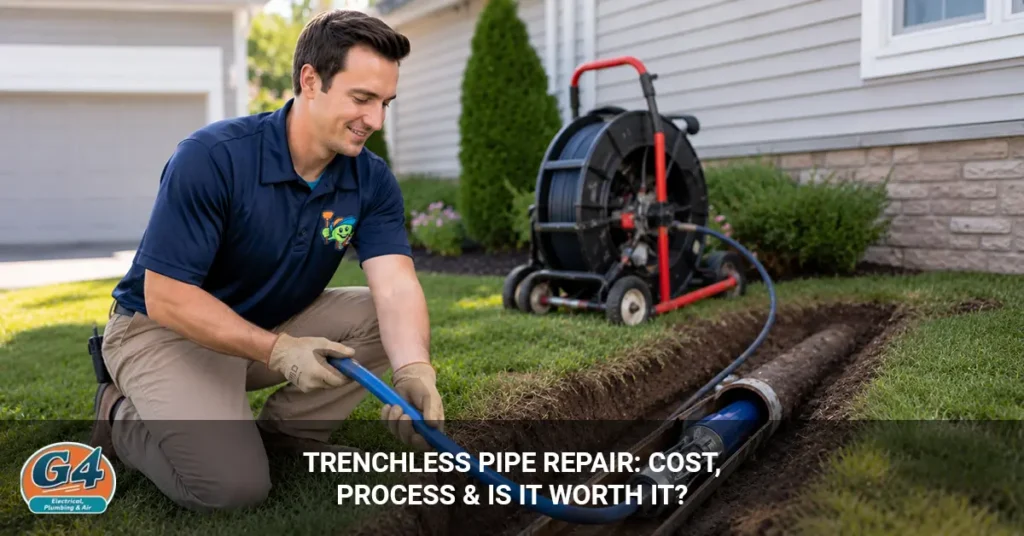
Trenchless pipe repair typically costs between $1,500 and $8,000, depending on the repair method, pipe length and diameter, the extent of the damage, and local labor rates. While the upfront repair cost may be higher than traditional excavation, trenchless repair often lowers the total project cost by minimizing digging and reducing the expense of restoring landscaping, driveways, sidewalks, patios, and other outdoor features.
If you’re dealing with recurring drain clogs, sewer backups, tree root intrusion, cracked pipes, or an aging underground plumbing system, trenchless pipe repair may provide a long-lasting solution without digging up your yard. Using proven methods such as Cured-In-Place Pipe (CIPP) lining and pipe bursting, licensed plumbers can repair or replace damaged sewer and drain pipes with minimal disruption to your property.
This guide explains how much trenchless pipe repair costs, what affects the price, how CIPP pipe lining and pipe bursting work, when trenchless repair is a better option than traditional excavation, and whether repairing or replacing the pipe offers the best long-term value. By the end, you’ll have the information you need to compare your options and choose the right solution for your home.
How Much Does Trenchless Pipe Repair Cost?
Trenchless pipe repair typically costs between $1,500 and $8,000, although larger or more complex projects can cost more. The final price depends on the repair method, the length and diameter of the pipe, the extent of the damage, accessibility, and local labor rates.
While trenchless repair often has a higher upfront cost than traditional spot repairs, it can lower the total project cost by reducing excavation and minimizing the need to restore landscaping, driveways, sidewalks, patios, irrigation systems, and other outdoor features. For many homeowners, these savings help offset the higher installation price.
The table below shows the average cost of common trenchless pipe repair services.
| Repair Type | Average Cost |
| CIPP pipe lining | $1,500–$6,500 |
| Pipe bursting | $3,000–$10,000 |
| Spot pipe repair | $500–$2,000 |
| Sewer camera inspection | $150–$500 |
| Hydro jetting (if needed) | $300–$800 |
These are national average price ranges. Your actual cost will depend on your pipe’s condition, the complexity of the repair, and your property’s specific conditions.
What Affects Trenchless Pipe Repair Cost?
The cost of trenchless pipe repair depends on the condition of the pipe, the repair method, and the complexity of the installation. Two homes with similar plumbing problems can have very different repair costs because underground pipe systems vary in age, material, accessibility, and the extent of the damage.
Several factors influence the final price:
- Repair methods: CIPP pipe lining and pipe bursting require different materials, equipment, and installation techniques, resulting in different costs.
- Pipe length: Longer pipes require more liner material, additional labor, and more installation time.
- Pipe diameter: Larger pipes require more repair material and specialized equipment, increasing both material and labor costs.
- Extent of the damage: Minor cracks or isolated leaks are usually less expensive to repair than severe corrosion, collapsed sections, or extensive tree root intrusion.
- Pipe material: Cast iron, clay, PVC, Orangeburg, and other pipe materials each present unique repair challenges that can affect the overall cost.
- Accessibility: Pipes beneath driveways, foundations, landscaping, or finished surfaces may require additional preparation before repairs can begin.
- Cleaning requirements: Many trenchless repairs require hydro jetting or mechanical cleaning to remove grease, debris, mineral buildup, and tree roots before installing a pipe liner.
- Permits and inspections: Depending on local regulations, permits and inspections may be required, adding to the total project cost.
- Local labor rates: Repair costs vary by region based on labor availability and the experience of local trenchless plumbing contractors.
- Emergency service: After-hours, weekend, or emergency repairs typically increase labor costs.
Most trenchless projects begin with a sewer camera inspection. This inspection allows the plumber to identify cracks, corrosion, root intrusion, pipe offsets, or collapsed sections and determine whether the pipe can be repaired using trenchless methods or if complete replacement is the better long-term solution.
The most accurate way to estimate your repair cost is to schedule an on-site inspection. After evaluating the condition of your plumbing system, a licensed plumber can recommend the most appropriate repair method and provide a detailed estimate based on your home’s specific needs.
What Is Trenchless Pipe Repair?
Trenchless pipe repair is a method of repairing or restoring underground pipes with little or no excavation. Instead of digging a trench to reach the damaged pipe, plumbers use specialized equipment to repair the pipe from the inside or restore it through small access points. This approach minimizes damage to lawns, landscaping, driveways, sidewalks, patios, and other structures above the pipe.
Trenchless technology is commonly used to repair sewer lines, drain pipes, and some underground water service lines. Depending on the condition of the existing pipe, a plumber may recommend Cured-In-Place Pipe (CIPP) lining to repair the pipe from the inside or pipe bursting to replace it without excavating the entire pipe route.
One of the biggest advantages of trenchless repair is that it restores underground pipes with far less disruption than traditional excavation. Because only small access points are needed, homeowners can often avoid the time, expense, and inconvenience of repairing damaged landscaping, driveways, sidewalks, patios, and other outdoor features.
Most trenchless pipe repair projects are completed within one day, although larger or more complex jobs may take two to three days. The timeline depends on the repair method, the length and condition of the pipe, and whether cleaning or other preparation is required before the repair begins.
Not every damaged pipe is a good candidate for trenchless repair. Pipes with severe structural damage or complete collapse may require trenchless replacement or traditional excavation instead. Before recommending a solution, a licensed plumber will perform a sewer camera inspection to evaluate the condition of the pipe and determine which repair method provides the safest and most reliable long-term result.
How Does Trenchless Pipe Repair Work?
Trenchless pipe repair restores or replaces damaged underground pipes without digging a trench along the entire pipe. The process begins with a sewer camera inspection, which allows a plumber to assess the condition of the pipe and determine the most effective repair method based on the type and extent of the damage.
Most trenchless repairs use one of two methods: Cured-In-Place Pipe (CIPP) lining or pipe bursting. While both minimize excavation, they’re designed for different situations. CIPP lining repairs the existing pipe from the inside, while pipe bursting replaces the damaged pipe with a new one.
CIPP Pipe Lining
This trenchless repair method creates a new, seamless pipe inside the existing one by inserting a flexible liner coated with epoxy resin. Once the liner cures, it forms a durable pipe within the original pipe, restoring structural integrity without extensive excavation.
Instead of removing the old pipe, plumbers insert a flexible liner saturated with epoxy resin into the damaged section. The liner is then inflated so it fits tightly against the inside of the pipe.
Once the epoxy cures, it hardens into a durable, corrosion-resistant pipe that seals cracks, small leaks, and minor joint separations. Because the repair is completed inside the existing pipe, extensive excavation is usually unnecessary.
CIPP lining is most effective when the original pipe is still structurally stable but has developed age-related damage such as corrosion, small cracks, leaking joints, or limited tree root intrusion. In these situations, lining can restore the pipe’s integrity without replacing the entire system.
When CIPP Pipe Lining Is the Best Choice
CIPP lining is typically recommended when the existing pipe can still support a new liner. It’s commonly used when:
- The pipe has cracks, small leaks, or minor joint separation.
- Tree roots have entered the pipe but haven’t caused major structural damage.
- Corrosion has weakened the pipe but hasn’t caused it to collapse.
- Homeowners want to avoid excavating driveways, patios, sidewalks, or landscaping.
Benefits of CIPP Pipe Lining
CIPP pipe lining offers several advantages:
- Repairs the existing pipe without extensive excavation.
- Creates a seamless, joint-free interior that helps reduce future leaks.
- Resists corrosion, root intrusion, and mineral buildup.
- Minimizes disruption to landscaping and hard surfaces.
- Can often be completed in a single day.
When CIPP Pipe Lining Isn’t the Best Option
CIPP lining isn’t suitable for every damaged pipe. If the pipe has completely collapsed, has severe offsets between sections, or has extensive structural failure, installing a liner may not provide a reliable repair. In these cases, pipe bursting or traditional excavation is often the better long-term solution.
A sewer camera inspection is the most reliable way to determine whether a damaged pipe can be repaired with CIPP lining or requires replacement instead.
Pipe Bursting
Pipe bursting replaces a damaged underground pipe by breaking apart the old pipe while simultaneously pulling a new pipe into its place. Unlike CIPP pipe lining, which repairs the existing pipe from the inside, pipe bursting completely replaces the damaged pipe without excavating its entire length.
To perform the replacement, plumbers dig a small access pit at each end of the existing pipe. A hydraulic bursting head is then pulled through the old pipe, fracturing it outward while pulling a new HDPE (high-density polyethylene) pipe into the same underground path. Because the replacement pipe follows the original route, only minimal excavation is required.
Pipe bursting is commonly used when the existing pipe has deteriorated beyond repair but its route can still be used for the new installation. It provides homeowners with the benefits of a completely new pipe while avoiding the extensive digging associated with traditional excavation.
When Pipe Bursting Is the Best Choice
Pipe bursting is usually the best option when a damaged pipe can’t be repaired with CIPP lining. It’s commonly recommended when:
- The pipe has extensive corrosion or structural deterioration.
- Large sections of the pipe have failed or are beyond repair.
- The entire pipe needs to be replaced rather than repaired.
- Homeowners want to avoid digging up driveways, landscaping, patios, or sidewalks.
Benefits of Pipe Bursting
Pipe bursting offers several advantages:
- Completely replaces the damaged pipe instead of repairing isolated sections.
- Requires only small access pits rather than a continuous trench.
- Minimizes damage to landscaping, driveways, sidewalks, and other outdoor features.
- Installs a durable HDPE pipe that can last 50 to 100 years.
- Reduces the risk of future leaks, corrosion, and root intrusion.
When Pipe Bursting Isn’t the Best Option
Pipe bursting isn’t suitable for every property. It may not be practical if the new pipe needs to follow a different route, underground utilities leave insufficient space for the bursting process, or site conditions prevent the safe use of specialized equipment.
A sewer camera inspection and site evaluation allow a licensed plumber to determine whether pipe bursting is the best solution or if CIPP pipe lining or traditional excavation will provide a more reliable long-term repair.
Pipe Lining vs. Pipe Bursting
Pipe lining repairs the existing pipe, while pipe bursting replaces it with a new one. Both are proven trenchless repair methods, but they’re designed for different types of pipe damage. The right choice depends on the condition of the existing pipe, the severity of the damage, and whether repairing or replacing the pipe provides the better long-term value.
The table below compares the two methods.
| Feature | CIPP Pipe Lining | Pipe Bursting |
| Existing pipe remains in place | Yes | No |
| Replaces the pipe | No | Yes |
| Best for cracks and minor structural damage | Yes | No |
| Suitable for severely damaged pipes | Limited | Yes |
| Internal pipe diameter | Slightly reduced | Maintains or can increase diameter |
| Typical cost | Lower | Higher |
Which Method Is Better?
Neither method is better in every situation because each is designed to solve a different problem. CIPP pipe lining is usually the better choice when the existing pipe is still structurally stable but has cracks, leaking joints, corrosion, or minor tree root intrusion. It restores the inside of the pipe without removing it, making it one of the least disruptive trenchless repair methods.
Pipe bursting is typically the better option when the existing pipe has extensive structural damage, has collapsed in multiple areas, or has reached the end of its service life. Because it installs a completely new HDPE pipe, it often provides the most reliable long-term solution for severely deteriorated plumbing systems.
The decision shouldn’t be based on cost alone. A sewer camera inspection allows a licensed plumber to evaluate the condition of the pipe, determine whether it can support a liner, and recommend the repair method that provides the safest, most durable, and most cost-effective long-term solution.
Trenchless Pipe Repair vs. Traditional Pipe Repair
Trenchless pipe repair restores underground pipes with minimal excavation, while traditional pipe repair requires digging directly to the damaged section. Although trenchless repair usually has a higher upfront cost, it can lower the total project cost by reducing excavation and minimizing the expense of restoring landscaping, driveways, sidewalks, patios, and other outdoor features.
The table below compares the two repair methods.
| Trenchless Pipe Repair | Traditional Pipe Repair |
| Minimal digging | Extensive excavation |
| Faster project completion | Longer repair timeline |
| Less property damage | Greater disruption to the yard |
| Higher upfront repair cost | Lower upfront repair cost |
| Lower restoration costs | Higher restoration costs |
| Ideal for pipes beneath landscaping or concrete | Better for easily accessible pipes |
Which Option Is More Cost-Effective?
Traditional repair often costs less to perform, but trenchless repair can provide better overall value. While trenchless methods require specialized equipment and experienced technicians, they often eliminate the need to repair lawns, landscaping, irrigation systems, driveways, sidewalks, and patios after the work is complete. On properties with expensive outdoor features, the savings on restoration can offset much of the higher installation cost.
Which Method Is Better for Your Property?
The best repair method depends on the location of the damaged pipe and its overall condition. Trenchless repair is often the better choice when the pipe runs beneath mature landscaping, driveways, sidewalks, patios, or building foundations where excavation would be costly and disruptive. Traditional repair may be more practical when the damaged section is easy to access or the pipe isn’t a suitable candidate for trenchless repair.
Which Repair Lasts Longer?
Both trenchless and traditional repairs can provide decades of reliable service when completed correctly. Long-term performance depends more on the repair method, pipe material, and installation quality than on whether excavation was required. Modern CIPP pipe liners and HDPE replacement pipes are designed to resist corrosion, leaks, and tree root intrusion, making them durable solutions for many underground plumbing systems.
A sewer camera inspection is the best way to determine which repair method is appropriate. After evaluating the condition of the pipe, a licensed plumber can recommend the option that offers the best balance of cost, durability, and long-term value.
Pros and Cons of Trenchless Pipe Repair
Trenchless pipe repair offers significant advantages, but it isn’t the right solution for every plumbing problem. Understanding its benefits and limitations can help you decide whether it’s the best long-term option for your home.
Pros
Minimal Excavation
Trenchless pipe repair requires little or no digging compared with traditional excavation. Most projects use only small access points, reducing disruption to your yard and minimizing cleanup after the repair.
Protects Landscaping and Hardscaping
One of the biggest advantages of trenchless repair is preserving your property. Lawns, gardens, driveways, patios, sidewalks, retaining walls, and other outdoor features usually remain intact, helping homeowners avoid expensive restoration work.
Faster Project Completion
Most trenchless pipe repairs are completed within one day. Because there’s far less excavation, the repair is often finished much faster than traditional methods, allowing your plumbing system to return to normal sooner.
Durable, Long-Lasting Repair
Modern CIPP pipe liners and HDPE replacement pipes are designed to provide decades of reliable service. They resist corrosion, leaks, mineral buildup, and tree root intrusion, making them a dependable long-term solution for many underground plumbing systems.
Lower Overall Project Costs
Although trenchless repair often costs more upfront, it can reduce the total cost of the project. By avoiding extensive excavation, homeowners typically spend less restoring landscaping, driveways, sidewalks, patios, and other outdoor structures.
Cons
Higher Upfront Cost
Trenchless repair usually has a higher initial price than traditional excavation. Specialized equipment, advanced materials, and experienced technicians contribute to the increased installation cost.
Not Suitable for Every Pipe
Some underground pipes can’t be repaired using trenchless methods. Pipes with complete collapse, severe structural failure, or certain underground conditions may require pipe bursting or traditional excavation instead.
Specialized Contractors Are Required
Not every plumbing company offers trenchless pipe repair. The work requires specialized equipment and technicians with experience in CIPP pipe lining and pipe bursting, so choosing a qualified contractor is important.
Camera Inspection Is Usually Required
Most trenchless repairs begin with a sewer camera inspection. Although this adds to the initial project cost, it allows the plumber to identify the exact cause of the problem and recommend the repair method that provides the best long-term result.
Is Trenchless Pipe Repair Worth It?
For many homeowners, trenchless pipe repair is worth the investment because it restores damaged underground pipes with minimal disruption to the property. Although the upfront repair cost is often higher than traditional excavation, the reduced expense of repairing landscaping, driveways, sidewalks, patios, and other outdoor features can make trenchless repair the more cost-effective option overall.
Trenchless repair is often the best choice when the damaged pipe runs beneath mature landscaping, concrete surfaces, retaining walls, or other structures that would be expensive or difficult to excavate. It’s also a practical solution if you want to complete the repair quickly, minimize disruption to your property, and avoid extensive cleanup after the project.
Traditional excavation may be the better option when the damaged section is easy to access, the pipe has suffered severe structural failure, or a sewer camera inspection shows that trenchless repair isn’t feasible. In these situations, excavation may provide a more reliable and cost-effective long-term solution.
Rather than comparing repair prices alone, evaluate the total project cost. Include excavation, property restoration, permit fees, labor, and the expected lifespan of the repair when comparing your options. In many cases, a higher upfront investment in trenchless repair can reduce overall expenses by avoiding costly restoration work and future repairs.
The best way to determine whether trenchless pipe repair is worth it is to schedule a professional plumbing inspection. A licensed plumber can assess the condition of the pipe, explain whether repair or replacement is the better choice, and recommend the solution that provides the best long-term value for your home.
Signs You May Need Trenchless Pipe Repair
Slow drains, recurring clogs, sewage backups, foul odors, and wet areas in your yard are common signs that an underground pipe may need repair. While some plumbing problems can be solved with routine drain cleaning, recurring issues often indicate damage inside the pipe that should be inspected before it leads to more extensive repairs.
The most reliable way to diagnose the problem is with a sewer camera inspection, which allows a licensed plumber to identify cracks, corrosion, tree root intrusion, pipe separation, or other structural damage without unnecessary excavation.
Slow Drains Throughout Your Home
Multiple slow drains often indicate a problem with the main sewer line rather than a single clogged fixture. If sinks, showers, bathtubs, and toilets all drain slowly, a damaged underground pipe may be restricting wastewater flow.
While a single fixture may simply have a blockage, multiple slow-draining sinks throughout the home often indicate a larger sewer or drain line problem.
Frequent Drain Clogs
Recurring drain clogs usually point to a larger problem than a simple blockage. If you repeatedly need drain cleaning or plunging, the pipe may have cracks, corrosion, tree root intrusion, or structural damage that requires repair.
If your drains keep clogging, recurring blockages may indicate a damaged underground pipe rather than a simple buildup inside the drain.
Sewage Backups
Sewage backing up into sinks, tubs, showers, or floor drains is a strong indication of a damaged sewer line. Because sewage contains harmful bacteria and contaminants, this problem should be inspected by a licensed plumber as soon as possible.
Foul Sewer Odors
Persistent sewer odors inside or outside your home may indicate a cracked or leaking underground pipe. Wastewater escaping through damaged pipes can produce unpleasant smells even when there are no visible signs of a leak.
Wet Spots or Sinkholes in the Yard
Wet patches, unusually green grass, or small sinkholes can indicate an underground pipe leak. Escaping wastewater saturates the surrounding soil and may eventually damage landscaping or create unstable ground around your property.
Tree Root Intrusion
Tree roots are one of the most common causes of underground pipe damage. As roots search for moisture, they can enter pipes through small cracks or joints, leading to recurring clogs, restricted flow, and progressive structural deterioration.
If you’re dealing with tree roots damaging your sewer line, early removal and repair can help prevent complete pipe failure and more expensive replacement.
Foundation Cracks or Soil Movement
A leaking underground pipe can gradually erode the soil beneath your property. Over time, this may contribute to uneven ground, foundation movement, or structural damage if the leak isn’t repaired.
Sewer Camera Inspection Confirms Pipe Damage
A sewer camera inspection is the most accurate way to determine whether trenchless pipe repair is possible. It allows plumbers to locate cracks, corrosion, root intrusion, pipe offsets, or collapsed sections and recommend the repair method that provides the best long-term solution.
How Long Does Trenchless Pipe Repair Take?
Most trenchless pipe repairs are completed within one day, although larger or more complex projects may take two to three days. The exact timeline depends on the repair method, the length and condition of the pipe, the extent of the damage, and whether additional preparation is required before the repair begins.
A typical project starts with a sewer camera inspection to evaluate the pipe and confirm that trenchless repair is the right solution. If needed, the pipe is then cleaned using hydro jetting or mechanical equipment to remove grease, debris, mineral buildup, and tree roots that could interfere with the repair.
Once the pipe has been prepared, the plumber completes the repair using either CIPP pipe lining or pipe bursting. After the installation, the repaired pipe is inspected, pressure tested or flow tested as appropriate, and returned to service.
Some projects take longer than others. Long pipe runs, severe tree root intrusion, difficult access, collapsed sections, or unexpected underground conditions can extend the repair timeline. Even so, trenchless pipe repair is generally much faster than traditional excavation because it requires far less digging and significantly reduces the time needed to restore your property afterward.
For most homeowners, this means less disruption to daily life and a faster return to normal plumbing service.
How Long Does Trenchless Pipe Repair Last?
A professionally completed trenchless pipe repair typically lasts 50 years or more, and some repair methods can provide a service life of up to 100 years. The exact lifespan depends on the repair method, pipe material, installation quality, soil conditions, and how well the plumbing system is maintained.
The table below shows the expected lifespan of the most common trenchless pipe repair methods.
| Repair Method | Expected Lifespan |
| CIPP pipe lining | 50+ years |
| Pipe bursting (HDPE pipe) | 50–100 years |
Modern CIPP pipe liners create a seamless, corrosion-resistant pipe inside the existing one, while HDPE replacement pipes installed through pipe bursting resist corrosion, tree root intrusion, mineral buildup, and many of the problems that affect older underground plumbing systems.
The long-term performance of any trenchless repair depends not only on the materials used but also on the quality of the installation. A properly installed repair can provide decades of reliable service with minimal maintenance, while poor workmanship can significantly shorten the life of the repair.
Many manufacturers offer warranties on trenchless repair materials, and some plumbing contractors provide separate workmanship warranties. Before approving the project, ask what warranties apply to both the materials and the installation so you understand the long-term protection included with your investment.
Can Every Pipe Be Repaired Without Digging?
No. Not every damaged pipe can be repaired using trenchless methods. While trenchless technology is an effective solution for many sewer lines, drain pipes, and some underground water lines, certain types of damage still require traditional excavation or complete pipe replacement.
Trenchless repair is usually possible when the existing pipe is structurally sound enough to support a CIPP pipe liner or can be replaced using pipe bursting. However, if the pipe has extensive structural failure or the site conditions prevent trenchless installation, excavation may be the safer and more reliable option.
Traditional excavation may still be necessary if:
- The pipe has completely collapsed.
- Large sections of the pipe are missing or severely damaged.
- Significant pipe offsets prevent a liner from passing through.
- Underground conditions make trenchless installation unsafe or impractical.
- Local building codes or permit requirements require excavation.
The only way to know whether trenchless repair is possible is through a sewer camera inspection. This inspection allows a licensed plumber to evaluate the condition of the pipe, identify the cause of the damage, and determine whether CIPP pipe lining, pipe bursting, or traditional excavation will provide the best long-term solution.
Repair or Replace: Which Is Better?
Whether you should repair or replace a damaged pipe depends on its condition, age, material, and long-term reliability. Minor cracks, isolated leaks, moderate corrosion, and limited tree root intrusion can often be repaired successfully with CIPP pipe lining. However, pipes with severe structural damage, repeated failures, or extensive deterioration are usually better candidates for replacement.
Repair is often the better option when:
- The pipe is still structurally stable.
- Damage is limited to cracks, small leaks, or minor root intrusion.
- A sewer camera inspection confirms the pipe can support a liner.
- You want to preserve landscaping and avoid unnecessary excavation.
Replacement is usually the better investment when:
- The pipe has collapsed or suffered major structural failure.
- Multiple sections have deteriorated or failed.
- The pipe has required frequent repairs over the years.
- The existing pipe material has reached the end of its expected service life.
Rather than comparing the repair price alone, consider the long-term value of each option. A lower-cost repair may not be the best investment if the pipe is likely to fail again in the near future. In many cases, replacing a severely deteriorated pipe can reduce future repair costs and provide greater long-term reliability.
The best way to make an informed decision is to schedule a professional sewer camera inspection. A licensed plumber can evaluate the condition of the pipe, explain whether repair or replacement is the more practical solution, and provide cost estimates so you can choose the option that offers the best long-term value for your home.
How to Choose the Right Trenchless Repair Method
The right trenchless repair method depends on the condition of the pipe, the results of a sewer camera inspection, and your long-term goals. While CIPP pipe lining is often the best choice for repairing structurally sound pipes, pipe bursting is usually recommended when the existing pipe has deteriorated beyond repair and needs to be replaced.
When comparing your options, consider:
- The results of the sewer camera inspection.
- The extent of the structural damage.
- The pipe’s material, age, and overall condition.
- Whether repairing or replacing the pipe provides better long-term value.
- The total project cost includes excavation, restoration, permits, and labor.
- The contractor’s experience with CIPP pipe lining and pipe bursting.
Don’t base your decision on price alone. A lower estimate may not provide the most durable solution if the pipe is nearing the end of its service life or has widespread structural damage. Likewise, the most expensive option isn’t always necessary if the existing pipe can be repaired reliably.
A licensed plumbing contractor can evaluate your system, explain the advantages and limitations of each trenchless repair method, and provide detailed estimates so you can choose the solution that offers the best balance of cost, durability, and long-term value for your home.
Frequently Asked Questions
How much does trenchless pipe repair cost?
Trenchless pipe repair typically costs between $1,500 and $8,000. The final price depends on the repair method, pipe length and diameter, the extent of the damage, accessibility, permit requirements, and local labor rates.
Is trenchless pipe repair covered by homeowners’ insurance?
Usually not. Most homeowners’ insurance policies don’t cover pipe repairs caused by normal wear and tear, corrosion, or aging. However, some policies cover damage resulting from a sudden covered event or offer optional service line coverage. Check your policy or contact your insurance provider to confirm your coverage.
Is trenchless pipe repair a permanent solution?
Yes. When installed correctly, trenchless pipe repair can provide a long-term solution. CIPP pipe liners typically last 50 years or more, while HDPE pipes installed through pipe bursting can last 50 to 100 years.
Can trenchless pipe repair fix tree root damage?
Yes, in many cases. After tree roots are removed and the pipe is cleaned, CIPP pipe lining can repair minor cracks and joints. If the pipe has extensive structural damage, pipe bursting may be the better long-term solution.
Can cast iron pipes be repaired with CIPP pipe lining?
Yes, many cast iron sewer and drain pipes can be repaired using CIPP pipe lining. The pipe must still be structurally stable enough to support the liner, which is why a sewer camera inspection is performed before the repair begins.
Does pipe lining reduce the size of the pipe?
Yes, but only slightly. The epoxy liner creates a new pipe inside the existing one, reducing the internal diameter by a small amount. In most residential plumbing systems, this has little or no noticeable impact on wastewater flow.
Is trenchless pipe repair better than traditional excavation?
It depends on the condition and location of the damaged pipe. Trenchless repair is often the better choice when you want to avoid digging up landscaping, driveways, patios, or sidewalks. Traditional excavation may still be necessary if the pipe has collapsed or isn’t suitable for trenchless repair.
How do plumbers know if trenchless pipe repair will work?
A sewer camera inspection is the most reliable way to determine whether trenchless pipe repair is possible. The inspection identifies cracks, corrosion, root intrusion, pipe offsets, and collapsed sections so the plumber can recommend the repair method that provides the safest and most durable long-term solution.
Final Thoughts
Trenchless pipe repair is a proven solution for restoring damaged underground pipes while minimizing excavation and protecting your property. Although it often costs more upfront than traditional excavation, the reduced expense of repairing landscaping, driveways, sidewalks, patios, and other outdoor features can make it the more cost-effective option in the long run.
Whether trenchless repair is the right choice depends on the condition of the existing pipe, the extent of the damage, and the results of a professional sewer camera inspection. In many cases, CIPP pipe lining provides a reliable solution for structurally sound pipes with cracks, leaks, or corrosion, while pipe bursting is the better option when the pipe has deteriorated beyond repair and requires complete replacement.
If you’re experiencing recurring drain clogs, slow drains, sewage backups, foul odors, or wet areas in your yard, don’t ignore the warning signs. Underground pipe problems rarely resolve on their own, and delaying repairs can lead to more extensive damage and higher costs.
A professional plumbing inspection can identify the cause of the problem, determine whether trenchless repair is possible, and help you choose the most durable and cost-effective solution for your home. Addressing the issue early can reduce future repair expenses, protect your property, and keep your plumbing system operating reliably for decades.