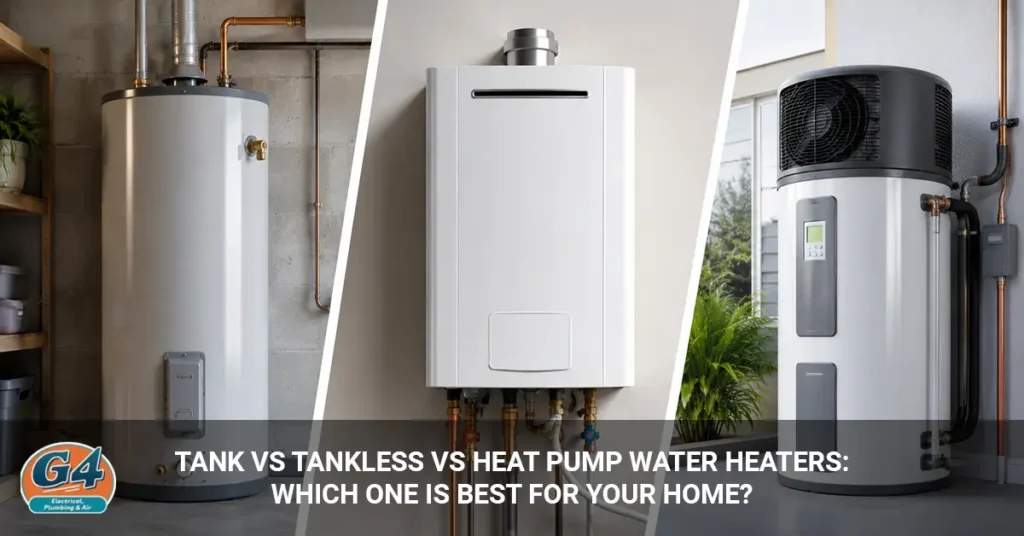
The best water heater for your home depends on your budget, hot water usage, energy-saving goals, and available space. Traditional tank water heaters offer the lowest upfront cost, tankless water heaters provide hot water on demand, and heat pump water heaters deliver the highest energy efficiency.
Choosing a new water heater is more than replacing an old appliance. The system you install today can affect your energy bills, comfort, maintenance costs, and long-term savings for years to come.
Many homeowners compare tank, tankless, and heat pump water heaters because each option offers different benefits. A standard tank water heater is often the most affordable to install. A tankless system can provide continuous hot water while taking up less space. A heat pump water heater uses less electricity and can significantly lower operating costs over time.
In this guide, you’ll learn how each type of water heater works, how much it costs to install and operate, how long it lasts, and which option makes the most sense for your household. By the end, you’ll have a clear understanding of which water heater delivers the best value for your needs.
Quick Comparison: Tank vs Tankless vs Heat Pump Water Heaters
Choosing between a tank, tankless, or heat pump water heater comes down to balancing upfront costs, energy efficiency, hot water demand, and long-term savings. Here’s a side-by-side comparison to help you quickly see the differences.
| Feature | Tank Water Heater | Tankless Water Heater | Heat Pump Water Heater |
| Upfront Cost | Low | High | High |
| Installation Cost | Lower | Moderate to High | Moderate to High |
| Energy Efficiency | Moderate | High | Very High |
| Lifespan | 8–12 Years | 15–20 Years | 10–15 Years |
| Hot Water Supply | Limited by Tank Size | Continuous | Limited by Tank Size |
| Maintenance | Low | Moderate | Moderate |
| Space Requirements | Moderate | Minimal | Larger |
| Best For | Budget-Friendly Replacements | Unlimited Hot Water | Maximum Energy Savings |
What Is the Difference Between Tank, Tankless, and Heat Pump Water Heaters?
The main difference between tank, tankless, and heat pump water heaters is how they heat and deliver hot water. A tank water heater stores and heats a set amount of water in a storage tank, making it the most common and affordable option. A tankless water heater heats water only when you need it, providing a continuous supply of hot water without using a storage tank. A heat pump water heater stores water in a tank but uses heat from the surrounding air to warm the water, making it the most energy-efficient choice for many homeowners.
A traditional tank water heater is often the best choice if keeping upfront costs low is your priority. For homeowners seeking an endless supply of hot water and a longer system lifespan, a tankless water heater can be a worthwhile investment. Meanwhile, a heat pump water heater typically provides the greatest long-term energy savings for those looking to reduce utility bills.
How Tank Water Heaters Work
Tank water heaters work by storing and heating a set amount of water inside an insulated tank until you need it. Most residential models hold between 30 and 80 gallons of water and keep it heated throughout the day so hot water is ready whenever you turn on a faucet, shower, or appliance.
When hot water leaves the tank, cold water enters through the supply line to replace it. The system then uses a gas burner or electric heating element to reheat the incoming water and maintain the set temperature. Because the water is stored and continuously heated, tank water heaters can provide reliable hot water for everyday household use.
Advantages of Tank Water Heaters
Tank water heaters are popular because they are affordable, easy to install, and simple to maintain. For many homeowners, they offer the most practical and budget-friendly solution when replacing an existing water heater.
Lower Initial Cost
Tank water heaters typically have the lowest upfront cost of the three options. Both the unit and installation are generally less expensive than tankless and heat pump systems, making them a good choice for homeowners looking to minimize replacement costs.
Simpler Installation
Most homes are already equipped for a traditional tank water heater. This often allows for a quicker installation with fewer plumbing, gas, or electrical modifications, which can help keep labor costs lower.
Easier Repairs
Tank water heaters have a straightforward design and use widely available replacement parts. Because plumbers work with these systems regularly, repairs are usually easier and less expensive than those for more advanced water heater technologies.
Disadvantages of Tank Water Heaters
While tank water heaters are affordable and reliable, they are generally less efficient and have a shorter lifespan than tankless and heat pump models.
Higher Energy Consumption
Tank water heaters continuously heat stored water, even when no one is using hot water. This standby heat loss can increase energy consumption and lead to higher utility bills over time.
Limited Hot Water Supply
The amount of hot water available depends on the size of the tank. Once the stored hot water is used up, you’ll need to wait for the system to heat a new supply of water before more hot water becomes available.
Shorter Lifespan
Most tank water heaters last between 8 and 12 years with proper maintenance. Learn the signs your water heater is failing so you can act before it becomes an emergency. While this lifespan is adequate for many homeowners, it is generally shorter than that of tankless water heaters.
Typical Costs of Tank Water Heaters
Tank water heaters are usually the most affordable option to purchase and install. Most homeowners can expect to pay between $1,000 and $2,500 for a professionally installed system, depending on the tank size, fuel type, efficiency rating, and local labor costs. See our full water heater replacement cost guide for a detailed breakdown.
Although the upfront cost is lower, it’s important to consider long-term operating expenses since tank water heaters typically use more energy than tankless and heat pump models.
How Tankless Water Heaters Work
Tankless water heaters work by heating water only when you need it instead of storing hot water in a tank. When you turn on a hot water faucet, cold water flows through the unit, where a gas burner or electric heating element quickly heats it before sending it to your shower, sink, or appliance.
Because there is no storage tank, tankless water heaters eliminate standby energy loss and provide hot water on demand. This makes them a popular choice for homeowners looking to improve energy efficiency and save space.
Advantages of Tankless Water Heaters
Tankless water heaters offer several benefits, including continuous hot water, improved efficiency, and a longer lifespan. While they cost more upfront, many homeowners find the long-term advantages worth the investment.
Endless Hot Water
Tankless water heaters can provide a continuous supply of hot water as long as the system’s flow rate is not exceeded. Unlike traditional tank systems, you won’t run out of hot water simply because the storage tank is empty.
This makes tankless units an excellent choice for households with high hot water usage, especially during busy mornings when multiple fixtures may be used throughout the day.
Improved Energy Efficiency
Tankless water heaters are generally more energy-efficient than traditional tank models because they only heat water when needed. Without a storage tank constantly maintaining water temperature, there is no standby heat loss.
Over time, this improved efficiency can help lower utility bills and reduce overall energy consumption.
Compact Design
Most tankless water heaters are mounted on a wall and take up significantly less space than traditional storage tanks. Their compact design makes them ideal for smaller homes, utility rooms, closets, and other areas where space is limited.
Longer Service Life
A properly maintained tankless water heater can last between 15 and 20 years. This longer lifespan often helps offset the higher initial investment compared to traditional tank water heaters.
Disadvantages of Tankless Water Heaters
Although tankless water heaters offer many benefits, they may not be the right fit for every home. Higher installation costs and flow rate limitations are important factors to consider.
Higher Installation Costs
Tankless water heaters typically cost more to purchase and install than traditional tank systems. Depending on your home’s setup, installation may require upgrades to gas lines, electrical systems, or venting, which can increase the overall project cost.
Flow Rate Limitations
While tankless systems provide continuous hot water, they can only heat a certain amount of water at one time. If multiple showers, appliances, and faucets are running simultaneously, the unit may struggle to meet demand unless it is properly sized for the household.
Maintenance Requirements
Tankless water heaters require routine maintenance to perform efficiently. In areas with hard water, mineral buildup can accumulate inside the system, making periodic descaling necessary to maintain performance and extend the unit’s lifespan. A water heater making a popping noise is often an early sign of this buildup.
Typical Costs of Tankless Water Heaters
Tankless water heaters generally have a higher upfront cost than traditional tank systems. Most homeowners can expect to pay between $2,000 and $5,500 for a professionally installed tankless water heater, depending on the unit size, fuel type, efficiency rating, and installation requirements. Visit our water heater installation cost guide to understand what’s included.
Although the initial investment is higher, the combination of energy savings, longer lifespan, and continuous hot water can make a tankless water heater a cost-effective choice over the long term.
Performance Comparison
Tankless, tank, and heat pump water heaters all provide reliable hot water, but their performance differs when it comes to hot water capacity, recovery speed, and handling household demand. Understanding these differences can help you choose the right system for your family’s needs.
Which Provides the Most Hot Water?
Tankless water heaters provide the most hot water because they heat water on demand rather than storing it in a tank. As long as the unit is properly sized and its flow rate is not exceeded, it can deliver a continuous supply of hot water for showers, laundry, and dishwashing.
Traditional tank water heaters and heat pump water heaters store a limited amount of hot water. Once the tank is depleted, you’ll need to wait for the system to heat a new supply of water before hot water is fully restored.
Recovery Rate Comparison
Recovery rate measures how quickly a water heater can produce more hot water after the available supply has been used. A faster recovery rate is especially important for households with high hot water demand.
- Tankless Water Heater: Provides hot water continuously because it heats water as it flows through the unit.
- Gas Tank Water Heater: Typically offers a fast recovery rate and can quickly reheat a new supply of water.
- Heat Pump Water Heater: Usually has a slower recovery rate when operating in energy-saving mode because it relies on heat transfer rather than direct heating.
For homes with heavy hot water usage, recovery rate can be just as important as tank size or energy efficiency.
Best Water Heater for Large Families
Large families generally need a water heater that can keep up with multiple showers, laundry loads, and appliance use throughout the day. The best option depends on your household’s hot water demand and budget.
High-demand households often benefit from:
- High-capacity tankless water heaters
- Multiple tankless units for larger homes
- Large-capacity heat pump water heaters
- High-capacity gas tank water heaters
A properly sized tankless system is often the best choice for families that frequently use hot water in several areas of the home at the same time.
Best Water Heater for Small Homes
Small homes typically have lower hot water demands, giving homeowners more flexibility when choosing a system. The best option often depends on available space, energy goals, and budget.
Common choices for smaller households include:
- Compact tankless water heaters
- Standard-size tank water heaters
- Smaller heat pump water heaters with adequate installation space
For homeowners looking to maximize space, a wall-mounted tankless water heater is often the most practical solution. Those seeking a lower upfront cost may find a traditional tank water heater to be the better fit.
Which Water Heater Is Best for Different Homeowners?
The best water heater depends on your budget, household size, hot water usage, and long-term goals. While some homeowners prioritize lower upfront costs, others focus on energy savings, unlimited hot water, or environmental impact. Here’s a quick guide to help you determine which option best fits your needs.
Best Choice for Budget-Conscious Homeowners
A traditional tank water heater is usually the best choice for homeowners looking to keep upfront costs low. Tank water heaters typically have the lowest purchase and installation costs, making them an affordable replacement option for most households.
If your existing water heater is failing and you want a straightforward replacement without major plumbing or electrical upgrades, a tank water heater often provides the best value.
Best Choice for Unlimited Hot Water
A tankless water heater is the best option if you want a continuous supply of hot water. Because it heats water on demand, a properly sized tankless system can provide hot water for extended showers, laundry, and other household activities without running out.
This makes tankless water heaters especially appealing for larger families or households with high daily hot water usage.
Best Choice for Maximum Energy Savings
A heat pump water heater offers the highest energy efficiency and the greatest potential savings on utility bills. By transferring heat from the surrounding air instead of generating heat directly, these systems use significantly less electricity than traditional water heaters.
Although the initial investment is higher, many homeowners recover the added cost through lower monthly energy expenses over time.
Best Choice for Long-Term Homeowners
Tankless and heat pump water heaters are often the best choices for homeowners planning to stay in their homes for many years. While these systems cost more upfront, their longer lifespan and lower operating costs can provide substantial savings over the long term.
If you’re thinking beyond the initial purchase price, investing in a more efficient water heater may offer better overall value.
Best Choice for Eco-Conscious Households
A heat pump water heater is generally the most environmentally friendly option. Its high efficiency reduces energy consumption and lowers greenhouse gas emissions compared to traditional tank water heaters.
For homeowners looking to reduce their environmental impact while also lowering energy costs, a heat pump water heater is often the most sustainable choice.
Tank vs Tankless vs Heat Pump Water Heaters: Pros and Cons at a Glance
Each type of water heater has strengths and drawbacks. The right choice depends on what matters most to you, whether that’s a lower upfront cost, maximum energy savings, unlimited hot water, or long-term value.
Tank Water Heater
Tank water heaters are best for homeowners who want the most affordable and straightforward water heating solution. They remain the most common option because of their lower purchase price and simple installation process.
Pros:
- Lowest upfront cost
- Easier and less expensive installation
- Widely available in various sizes
- Simple repairs and maintenance
- Familiar technology for most homeowners
Cons:
- Higher energy consumption due to standby heat loss
- Limited hot water supply based on tank size
- Shorter lifespan compared to tankless models
- May run out of hot water during heavy use
Tankless Water Heater
Tankless water heaters are ideal for homeowners who want continuous hot water and improved energy efficiency. By heating water only when needed, they eliminate the limitations of a storage tank.
Pros:
- Continuous hot water on demand
- More energy-efficient than traditional tank systems
- Compact, wall-mounted design
- Longer lifespan, often 15–20 years
- No standby heat loss
Cons:
- Higher installation costs
- May require gas, electrical, or venting upgrades
- Flow rate limitations during peak demand
- Professional sizing is critical for optimal performance
Heat Pump Water Heater
Heat pump water heaters are the best choice for maximizing energy efficiency and reducing long-term operating costs. They use heat from the surrounding air to warm water, making them one of the most efficient water heating options available.
Pros:
- Lowest operating costs among the three options
- Exceptional energy efficiency
- Potential utility rebates and tax incentives
- Reduced environmental impact
- Lower monthly energy bills
Cons:
- Higher upfront purchase and installation costs
- Requires more installation space
- Slower recovery rate in some operating modes
- Performance can be affected by cooler installation environments
When comparing the pros and cons, tank water heaters generally offer the lowest upfront investment, tankless water heaters provide the best hot water performance, and heat pump water heaters deliver the greatest long-term energy savings.
Frequently Asked Questions
Is a heat pump water heater better than a tankless water heater?
A heat pump water heater is better for energy savings, while a tankless water heater is better for unlimited hot water. Heat pump models use significantly less electricity and typically have lower operating costs. Tankless systems, on the other hand, provide hot water on demand and take up less space. The better option depends on whether your priority is reducing utility bills or maximizing hot water availability.
Which water heater saves the most money?
Heat pump water heaters generally save the most money over the long term. Their high energy efficiency can significantly reduce monthly utility costs compared to traditional tank water heaters. Although the upfront cost is higher, many homeowners recover that investment through lower energy bills and available rebates or tax incentives.
Do tankless water heaters lower energy bills?
Yes, tankless water heaters can lower energy bills because they only heat water when it’s needed. Unlike traditional tank water heaters, they don’t continuously maintain a tank of hot water, which eliminates standby heat loss. The amount you save depends on your household’s hot water usage and local energy costs.
How long do heat pump water heaters last?
Most heat pump water heaters last between 10 and 15 years with proper maintenance. Regular tank flushing, air filter cleaning, and routine inspections can help extend the system’s lifespan and maintain its efficiency.
Are heat pump water heaters worth the investment?
For many homeowners, heat pump water heaters are worth the investment because they offer substantial energy savings over time. Their lower operating costs, potential rebates, and environmental benefits often offset the higher initial purchase price, especially for homeowners planning to stay in their homes for several years.
Which water heater requires the least maintenance?
Traditional tank water heaters generally require the least maintenance because of their simple design. Basic tasks such as flushing the tank and checking the anode rod are usually sufficient to keep the system operating efficiently. Tankless and heat pump water heaters may require additional maintenance, such as descaling or air filter cleaning, depending on the model and water conditions.
Final Verdict: Which Water Heater Should You Choose?
The best water heater for your home depends on your budget, hot water needs, energy-saving goals, and how long you plan to stay in your home. There is no one-size-fits-all solution, but understanding the strengths of each option can help you make the right choice.
Choose a tank water heater if your main priority is keeping upfront costs low. Traditional tank systems are affordable, easy to install, and provide reliable performance for most households. They are often the best choice for homeowners looking for a simple replacement without major upgrades.
Choose a tankless water heater if you want a continuous supply of hot water, a longer lifespan, and improved energy efficiency. Tankless systems work well for families with higher hot water demands and homeowners who want to save space with a compact, wall-mounted unit.
Choose a heat pump water heater if your goal is to maximize energy efficiency and lower monthly utility bills. Although the initial investment is higher, the long-term savings can make a heat pump water heater one of the most cost-effective options over its lifetime.
For a quick recommendation:
- Lowest Upfront Cost: Tank Water Heater
- Unlimited Hot Water: Tankless Water Heater
- Highest Energy Efficiency: Heat Pump Water Heater
- Best Long-Term Savings: Heat Pump Water Heater
- Longest Lifespan: Tankless Water Heater
While traditional tank water heaters remain a popular choice because of their affordability, many homeowners are choosing tankless and heat pump systems for their long-term benefits. Comparing installation costs, operating expenses, available space, and household hot water usage will help you select the system that delivers the best value for your home.
If you’re planning a water heater replacement, a licensed plumbing professional can evaluate your home’s hot water demand and recommend the right size and type of system for your needs. If you’re already experiencing issues, check our no hot water troubleshooting guide to identify the problem first. Professional guidance can help ensure you get the best combination of comfort, efficiency, and long-term performance.