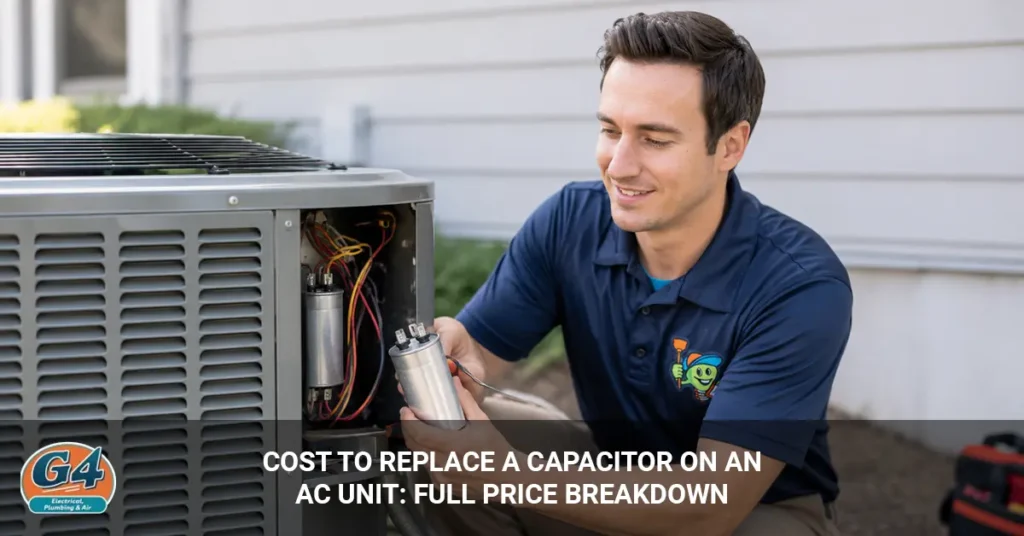
If your air conditioner won’t start or suddenly stops cooling, a bad capacitor could be the problem. The good news is that replacing an AC capacitor is usually one of the least expensive air conditioning repairs. In most cases, homeowners pay between $120 and $450, including the replacement part and professional labor.
Although the capacitor is a small component, it plays a critical role in your air conditioner. It stores and releases electricity to help the compressor and fan motors start and run properly. When it fails, your AC may struggle to turn on, blow warm air, make a humming noise, or stop working altogether.
The final replacement cost depends on several factors, including the type of capacitor your system uses, your air conditioner’s brand, local labor rates, and whether you need emergency service outside normal business hours.
This guide explains everything you need to know about AC capacitor replacement costs. You’ll learn what affects the price, the different types of capacitors, common signs of failure, and when it’s time to call an HVAC professional. By the end, you’ll know what a fair repair cost looks like and how replacing a faulty capacitor early can help prevent more expensive damage to your air conditioning system.
Average Cost to Replace an AC Capacitor
Replacing an AC capacitor typically costs between $120 and $450, with most homeowners paying around $220 to $300 for a standard repair. The final price depends on the type of capacitor, your HVAC system, local labor rates, and whether the repair is completed during regular business hours or as an emergency service.
The capacitor itself is relatively inexpensive, usually costing $15 to $80. Most of the total cost comes from the technician’s time to diagnose the issue, replace the faulty part, and test the system to ensure it’s operating safely and efficiently.
In most cases, replacing a capacitor is a straightforward repair that takes 30 to 60 minutes. If the capacitor is the only problem, it’s often one of the quickest and most affordable air conditioner repairs.
Average AC Capacitor Replacement Cost
| Cost Category | Average Cost |
| Capacitor Only | $15–$80 |
| Labor | $80–$250 |
| Service Call Fee | $60–$150 |
| Total Replacement Cost | $120–$450 |
| Emergency or After-Hours Service | $250–$600+ |
Most HVAC companies charge a diagnostic or service call fee, which may be included in the total repair cost. Some contractors also waive this fee if you approve the repair during the same visit. Before scheduling service, it’s worth asking how the company structures its pricing so there are no surprises.
If you’re comparing capacitor replacement with other common air conditioning repairs, our guide to AC repair cost explains the average price homeowners pay for various AC problems and what factors affect the total repair bill.
What Does the Replacement Cost Include?
Professional AC capacitor replacement includes more than simply swapping out the old part. A qualified HVAC technician will inspect the system, confirm the capacitor is causing the problem, and test the air conditioner after the repair to make sure everything is working correctly.
A typical service visit includes:
- Diagnosing the electrical issue
- Disconnecting power and safely inspecting the system
- Removing the failed capacitor
- Installing the correct replacement capacitor
- Checking voltage and electrical connections
- Testing the compressor and fan motor
- Running the air conditioner to verify proper operation
If the technician finds additional issues such as a worn contactor, damaged condenser fan motor, or other electrical problems, the total repair cost may be higher. Addressing these issues during the same visit can often help prevent more expensive breakdowns later.
AC Capacitor Replacement Cost by Capacitor Type
The cost to replace an AC capacitor depends on the type of capacitor your air conditioner uses. Most residential systems have a run capacitor, start capacitor, or dual run capacitor. While all three perform similar electrical functions, they work differently and vary slightly in price.
The good news is that capacitor replacement is generally one of the most affordable HVAC repairs, regardless of the type. However, the total cost can increase based on labor rates, the quality of the replacement part, and your HVAC system’s specifications.
Run Capacitor Replacement Cost
Replacing a run capacitor typically costs between $120 and $300, including parts and labor. The capacitor itself usually costs $15 to $50, making labor and the service call the biggest part of the repair bill.
A run capacitor supplies a steady flow of electricity to the compressor and condenser fan motor while your air conditioner is running. Unlike a start capacitor, which is only used during startup, the run capacitor works throughout the entire cooling cycle. Because it’s constantly in use, it naturally wears out over time.
Fortunately, replacing a faulty run capacitor is usually quick and inexpensive, especially if the problem is diagnosed before it causes damage to other components.
Common Signs of a Bad Run Capacitor
A failing run capacitor often gives warning signs before it stops working completely. Watch for these common symptoms:
- The air conditioner struggles to start or stay running.
- The system blows warm air instead of cold air.
- The outdoor condenser unit makes a humming or buzzing noise.
- The condenser fan isn’t spinning properly.
- The compressor frequently turns on and off (short cycling).
- Your energy bills increase without a change in cooling habits.
- The air conditioner takes longer than usual to cool your home.
If you notice one or more of these symptoms, it’s best to have your AC inspected as soon as possible. Replacing a worn-out run capacitor early can prevent additional strain on the compressor and fan motor, helping you avoid more expensive repairs later.
Start Capacitor Replacement Cost
Replacing a start capacitor typically costs between $150 and $350, including parts and labor. The start capacitor itself usually costs $20 to $60, while the remaining cost covers the technician’s diagnosis, installation, and system testing.
A start capacitor gives the compressor an extra burst of electricity when your air conditioner first turns on. Once the compressor reaches its normal operating speed, the start capacitor automatically disconnects and is no longer used until the next startup.
Not every central air conditioner has a separate start capacitor. Many modern residential systems use only a run capacitor, while others are equipped with both a start capacitor and a run capacitor to improve startup performance and reduce stress on the compressor.
Since a start capacitor is only active for a few seconds during each startup, it experiences much less wear than a run capacitor. As a result, it often lasts longer and fails less frequently.
Signs of a Bad Start Capacitor
A failing start capacitor can make it difficult for your air conditioner to start properly. Common symptoms include:
- The outdoor unit won’t start.
- You hear a clicking or humming sound, but the compressor doesn’t turn on.
- The AC takes several attempts to start.
- The circuit breaker trips when the system starts.
- The compressor overheats due to repeated hard starts.
If the start capacitor fails completely, your air conditioner may not start at all. Replacing it promptly can restore normal operation and help protect the compressor from unnecessary strain and costly damage.
Dual Run Capacitor Replacement Cost
Replacing a dual-run capacitor typically costs between $150 and $350, including parts and labor. The replacement capacitor usually costs $20 to $80, while the rest of the cost covers the service call, installation, and testing.
A dual-run capacitor combines the functions of two capacitors into a single component. It provides power to both:
- The compressor
- The condenser fan motor
Because it serves two critical components, a dual-run capacitor is commonly used in modern central air conditioning systems. This design reduces the number of electrical parts inside the outdoor unit, simplifies maintenance, and saves space.
Although a dual-run capacitor costs slightly more than a standard run capacitor, it’s still one of the least expensive AC repairs. In most cases, replacing it takes less than an hour and can quickly restore your system’s cooling performance.
Signs of a Bad Dual Run Capacitor
A failing dual-run capacitor can affect both the compressor and the condenser fan motor at the same time. Common signs include:
- The air conditioner won’t start.
- The outdoor fan isn’t spinning.
- The compressor struggles to start or won’t run.
- Warm air blows from the vents.
- The outdoor unit makes a humming or buzzing noise.
- The system shuts off unexpectedly or cycles too short.
- Cooling performance decreases even though the thermostat is set correctly.
If you notice these symptoms, have your air conditioner inspected promptly. Replacing a faulty dual-run capacitor early can help prevent damage to more expensive components, such as the compressor or condenser fan motor.
What Factors Affect AC Capacitor Replacement Cost?
The cost to replace an AC capacitor depends on more than just the price of the part. Factors such as the capacitor’s size, voltage rating, HVAC brand, labor rates, and emergency service can all affect your final repair bill.
Understanding these factors can help you know what you’re paying for and determine whether the estimate from an HVAC contractor is reasonable.
Capacitor Size (Microfarad Rating)
The capacitor’s microfarad (µF) rating is one of the biggest factors that affects the replacement cost. The microfarad rating determines how much electrical energy the capacitor can store and deliver to your air conditioner’s components.
Common capacitor sizes used in residential AC systems include:
- 30/5 µF
- 35/5 µF
- 40/5 µF
- 45/5 µF
- 50/5 µF
- 55/5 µF
- 60/5 µF
Larger-capacity capacitors usually cost slightly more, but the difference is generally small. In most cases, the variation in price is only a few dollars.
More importantly, the replacement capacitor must match the manufacturer’s recommended microfarad rating. Installing the wrong size can reduce your air conditioner’s efficiency, cause hard starting, shorten the lifespan of the compressor or fan motor, and lead to additional repairs.
For that reason, HVAC technicians always verify the correct µF rating before installing a new capacitor.
Voltage Rating
The capacitor’s voltage rating also affects both its price and performance. Most residential air conditioners use either a 370-volt or 440-volt capacitor.
The two most common voltage ratings are:
- 370V
- 440V
A 440V capacitor can usually replace a 370V capacitor if the microfarad rating is identical and it fits the unit. However, a 370V capacitor should never replace a 440V capacitor, as it may fail prematurely under higher electrical loads.
Capacitors with a 440V rating typically cost a little more because they’re designed to handle greater electrical stress and often have a longer service life. Many HVAC professionals choose 440V capacitors as replacement parts because they offer improved durability without affecting system performance when used correctly.
HVAC Brand
Your air conditioner’s brand can affect the cost of replacing a capacitor, although the difference is usually small. In many cases, the same type of capacitor is compatible with multiple HVAC brands, which helps keep repair costs affordable.
Some of the most common residential HVAC brands include:
- Carrier
- Trane
- Lennox
- Goodman
- Rheem
- American Standard
- York
- Bryant
- Ruud
- Amana
For most repairs, HVAC technicians use high-quality universal capacitors that match the manufacturer’s required microfarad (µF) and voltage ratings. These replacement parts are reliable, readily available, and often cost less than brand-specific components.
However, some air conditioning systems may require original equipment manufacturer (OEM) parts to meet warranty requirements or manufacturer specifications. OEM capacitors typically cost more than universal replacements, which can increase the total repair bill.
The brand of your HVAC system can also influence labor costs. Premium brands or high-end systems may require specialized parts, additional testing, or technicians with brand-specific experience. While this doesn’t always result in a significantly higher repair cost, it can increase the overall price in some cases.
In most situations, the quality of the replacement capacitor and the technician’s expertise are more important than the brand name itself. Installing the correct capacitor that matches your system’s specifications helps ensure reliable performance and can extend the life of your compressor and fan motor.
Labor Costs
Labor is usually the largest part of the total cost to replace an AC capacitor. While the replacement part itself is relatively inexpensive, you’re also paying for the technician’s time, expertise, and equipment to diagnose the problem and ensure your air conditioner is operating safely.
Most HVAC companies charge either a flat-rate repair fee, an hourly labor rate, or a diagnostic fee plus labor. In general, labor costs range from $80 to $250, depending on your location and the complexity of the repair.
Although replacing a capacitor often takes less than an hour, the service visit includes much more than installing a new part. The technician must diagnose the issue, safely disconnect power, verify the correct replacement capacitor, install it, and test the entire system before leaving. That’s why labor makes up a significant portion of the final repair bill.
Service Call Fees
Many HVAC companies charge a separate service call or diagnostic fee before performing any repairs. This fee typically covers the technician’s travel time, inspection, and troubleshooting to identify the cause of the problem.
Service call fees generally range from $60 to $150. Some companies include this fee in their flat-rate pricing, while others waive it if you approve the repair during the same visit.
Before scheduling service, ask whether the diagnostic fee is included in the quoted price. Understanding the pricing structure upfront can help you avoid unexpected charges.
Emergency or After-Hours Repairs
Emergency AC repairs usually cost more than repairs completed during normal business hours. If your air conditioner fails during a heat wave, on a weekend, late at night, or on a holiday, you can expect to pay a premium for faster service.
Emergency capacitor replacement typically costs between $250 and $600 or more, depending on the time of service, your location, travel distance, and the contractor’s pricing policies.
If your home remains safe and comfortable, waiting until regular business hours can often reduce the overall repair cost without affecting the quality of the service.
Local Labor Rates
Where you live can have a noticeable impact on the cost of AC capacitor replacement. HVAC labor rates are generally higher in large cities and areas with a higher cost of living. Prices also tend to increase during the peak cooling season when technicians are in high demand.
Homeowners in smaller towns or rural areas often pay less for the same repair because labor costs and operating expenses are typically lower.
To make sure you’re getting a fair price, it’s a good idea to request estimates from two or three licensed HVAC contractors. Comparing quotes can help you understand local pricing and choose a company that offers quality service at a reasonable cost.
Signs Your AC Capacitor Needs Replacement
A failing AC capacitor usually gives several warning signs before it stops working completely. If you notice these symptoms early, you may be able to replace the capacitor before it damages more expensive components like the compressor or condenser fan motor.
Here are the most common signs that your AC capacitor may need to be replaced.
AC Won’t Start
If your air conditioner won’t start, a bad capacitor could be preventing the compressor or fan motor from turning on. You may hear the thermostat click or notice a faint humming sound from the outdoor unit, but the system never starts cooling.
The capacitor provides the electrical boost needed to start your air conditioner. When it fails, the compressor or fan motor may not have enough power to begin running.
If your AC repeatedly fails to start, turn it off and have it inspected. Continuing to restart the system can put extra strain on the compressor and other electrical components.
Warm Air Is Coming From the Vents
Warm air coming from your vents can be a sign of a weak or failing capacitor. If the indoor blower is running but the compressor isn’t, your air conditioner will circulate air without actually cooling it.
A failed capacitor is just one reason an AC is not cooling properly. Low refrigerant, dirty coils, thermostat issues, and airflow restrictions can cause similar symptoms, so a professional diagnosis is the best way to identify the exact problem.
While warm airflow can have several causes, such as low refrigerant or a dirty air filter, a failed capacitor is one of the most common electrical issues behind this symptom.
If your thermostat is set to cool but your home isn’t getting colder, it’s time to have the system checked.
Humming Noise From the Outdoor Unit
A humming or buzzing sound from the outdoor unit often means the capacitor is failing. The compressor or condenser fan may be trying to start but doesn’t have enough electrical power to get moving.
If you hear a continuous humming noise for more than a few seconds, turn the air conditioner off. Letting the motor struggle to start can cause overheating and lead to more expensive repairs.
Outdoor Fan Isn’t Spinning
If the outdoor fan isn’t spinning, the capacitor may no longer be supplying power to the fan motor. In many cases, you’ll hear the outdoor unit running, but the fan blades remain still, and your home won’t cool properly.
Without the condenser fan, heat can’t escape from the system. This can cause the compressor to overheat and may eventually shut the air conditioner down to prevent further damage.
AC Cycles On and Off Frequently
Frequent short cycling can be another sign of a failing capacitor. A weak capacitor may allow the air conditioner to start occasionally but not provide enough power to keep it running through a full cooling cycle.
Although a faulty capacitor can trigger AC short cycling, other problems such as an oversized system, thermostat issues, or refrigerant problems may also cause frequent on-and-off cycling.
Short cycling reduces energy efficiency, makes it harder to maintain a comfortable indoor temperature, and places extra wear on the compressor. If your AC starts and stops every few minutes, it’s worth having the capacitor tested.
Higher Electricity Bills
An unexpected increase in your energy bill may be caused by a weak AC capacitor. As the capacitor begins to fail, the compressor and fan motors have to work harder to keep the system running, which increases electricity usage.
If your cooling habits haven’t changed but your utility bills continue to climb, a worn capacitor could be one of the reasons your system is operating less efficiently.
Burning Smell or Visible Damage
A burning smell or visible damage around the capacitor is a clear sign that it needs immediate replacement. In some cases, the capacitor may overheat and fail suddenly.
Common warning signs include:
- A burning electrical smell near the outdoor unit
- A swollen or bulging capacitor
- Oil is leaking from the capacitor
- Burn marks or melted wiring around the electrical compartment
If you notice any of these signs, turn off your air conditioner immediately and avoid using it until it has been inspected by a licensed HVAC technician. Continuing to run the system can increase the risk of damaging the compressor or other electrical components, leading to a much more expensive repair.
What Causes an AC Capacitor to Fail?
AC capacitors usually fail because they wear out over time, but heat, electrical problems, and poor maintenance can shorten their lifespan. While most capacitors are built to last for years, constant use and harsh operating conditions eventually reduce their ability to hold and release an electrical charge.
Here are the most common reasons an AC capacitor fails.
Age and Normal Wear
Normal wear is the most common cause of capacitor failure. Most AC capacitors last 8 to 15 years, depending on how often your air conditioner runs and the conditions it operates in.
Every time your AC starts, the capacitor stores and releases electricity to help power the compressor and fan motor. After thousands of cooling cycles, it gradually loses its ability to hold a charge. As the capacitor weakens, your air conditioner may become harder to start or stop cooling efficiently.
For older air conditioning systems, replacing a worn capacitor is considered a routine repair and is often much less expensive than replacing major components.
High Outdoor Temperatures
Extreme heat can significantly shorten the life of an AC capacitor. The hotter the weather, the harder your air conditioner has to work, which means the capacitor is exposed to more heat and electrical stress.
In regions with long, hot summers, the system runs for more hours each day. Over time, this extra workload causes the capacitor to wear out faster than it would in cooler climates.
Keeping the outdoor unit clean and ensuring proper airflow can help reduce heat buildup and extend the life of the capacitor.
Power Surges and Voltage Fluctuations
Power surges and unstable voltage can damage an AC capacitor without warning. Lightning strikes, utility outages, and sudden voltage spikes place stress on the capacitor and other electrical components.
Even small voltage fluctuations that occur regularly can gradually weaken the capacitor, reducing its performance and lifespan.
Installing a whole-home surge protector or a surge protector designed specifically for HVAC systems can help protect your air conditioner from electrical damage.
Dirty Condenser Coils
Dirty condenser coils make your air conditioner work harder, which increases wear on the capacitor. When the outdoor coils are covered with dirt, dust, grass clippings, or leaves, they can’t release heat efficiently.
As a result, the compressor runs longer and generates more heat inside the outdoor unit. This added stress affects several components, including the capacitor, and can lead to premature failure.
Cleaning the outdoor condenser regularly and scheduling annual maintenance can help improve efficiency and reduce unnecessary strain on your system.
Poor Installation or Incorrect Replacement Parts
Using the wrong capacitor or installing it incorrectly can lead to early failure. Every air conditioner is designed to use a capacitor with a specific microfarad (µF) and voltage rating. Installing a capacitor that doesn’t match the manufacturer’s specifications can reduce performance and place additional stress on the compressor and fan motor.
Low-quality replacement parts can also fail sooner than high-quality components.
That’s why it’s important to have a qualified HVAC technician verify the correct capacitor size and voltage before installation. Using the right replacement part helps ensure reliable performance, improves system efficiency, and can prevent costly damage to other HVAC components.
Can You Replace an AC Capacitor Yourself?
Yes, you can replace an AC capacitor yourself, but it’s generally not recommended unless you have experience working with HVAC electrical systems. While the replacement part is inexpensive, the repair involves high-voltage components that can remain dangerous even after the power is turned off.
For most homeowners, hiring a licensed HVAC technician is the safest option and helps prevent costly mistakes.
Safety Risks
Replacing an AC capacitor can be dangerous because the capacitor can still hold an electrical charge after the system has been switched off. Touching a charged capacitor without properly discharging it can result in a serious electrical shock.
There are also other risks to consider. Installing the wrong capacitor, wiring it incorrectly, or using an incompatible replacement part can damage the compressor or fan motor. In some cases, DIY repairs may also void the manufacturer’s warranty if the work isn’t performed according to the equipment’s specifications.
Although replacing a capacitor may seem straightforward, working around high-voltage electrical components always carries some level of risk.
DIY Cost
Replacing an AC capacitor yourself usually costs between $15 and $80 for the replacement part. At first glance, this makes DIY repair seem like an easy way to save money.
However, the capacitor is only one part of the job. You also need the correct replacement with the proper microfarad (µF) and voltage rating, insulated tools, and electrical testing equipment to confirm the repair was successful. More importantly, you need to know how to safely discharge the capacitor and verify that it is actually the source of the problem.
If the wrong capacitor is installed or the real issue is misdiagnosed, the repair could end up costing far more than hiring a professional in the first place.
Benefits of Hiring an HVAC Professional
A licensed HVAC technician can safely replace the capacitor and confirm that no other components have been damaged. What appears to be a bad capacitor can sometimes be caused by another electrical issue, such as a faulty contactor, damaged fan motor, or compressor problem.
A professional will inspect the system, identify the root cause of the failure, install the correct replacement capacitor, and test the air conditioner before completing the repair. Many HVAC companies also back their work with a warranty on both the replacement part and labor, giving you added peace of mind.
Professional installation also reduces the risk of accidental damage to expensive components like the compressor, which can cost thousands of dollars to replace.
DIY vs. Professional AC Capacitor Replacement
| DIY Replacement | Professional Replacement |
| Lower upfront cost | Accurate diagnosis of the problem |
| Risk of electrical shock | Safe installation by a trained technician |
| Possibility of choosing the wrong capacitor | Correct capacitor matched to your system |
| No labor warranty | Parts and labor warranty included by many companies |
| Greater risk of damaging other HVAC components | Full system testing after the repair |
For most homeowners, professional capacitor replacement is the better investment. The repair is usually completed in less than an hour, the cost is relatively affordable, and you’ll have confidence that your air conditioner is operating safely and efficiently. Spending a little more on professional service today can help you avoid much larger repair bills later.
How Long Does It Take to Replace an AC Capacitor?
Replacing an AC capacitor usually takes 30 to 60 minutes from start to finish. The actual installation of the new capacitor typically takes only 15 to 30 minutes, but the total service visit also includes diagnosing the problem, testing the system, and making sure your air conditioner is operating safely before the technician leaves.
During the appointment, the HVAC technician will first confirm that the capacitor is the source of the problem. After safely disconnecting the power, they’ll remove the faulty capacitor, install a replacement with the correct microfarad (µF) and voltage rating, inspect the electrical connections, and test the system to verify that the compressor and fan motor are working properly.
If the capacitor is the only failed component, the repair is usually completed within an hour. However, the visit may take longer if the technician discovers additional issues, such as a faulty contactor, a damaged condenser fan motor, or compressor-related problems that require further diagnosis or repair.
Because capacitor replacement is a relatively quick and affordable repair, addressing the problem early can often restore your air conditioner’s performance before it leads to more serious and expensive damage.
How Long Does an AC Capacitor Last?
Most residential AC capacitors last between 8 and 15 years. However, their actual lifespan depends on how often your air conditioner runs, the local climate, and how well the system is maintained.
Capacitors naturally wear out over time because they store and release electricity every time your air conditioner starts and runs. As they age, they gradually lose their ability to hold an electrical charge, making it harder for the compressor and fan motor to operate efficiently.
Several factors can shorten a capacitor’s lifespan. Air conditioners that run for long hours during hot summers place more stress on the capacitor than systems used only occasionally. Constant exposure to direct sunlight can also increase temperatures inside the outdoor unit, accelerating wear. In addition, frequent power surges, poor maintenance, and dirty condenser coils force the system to work harder, reducing the life of the capacitor.
Routine HVAC maintenance is one of the best ways to maximize the lifespan of your capacitor. During an annual tune-up, a technician can test the capacitor’s performance and identify signs of wear before it fails completely. Replacing a weak capacitor during scheduled maintenance is often less expensive and more convenient than dealing with an unexpected breakdown on a hot day.
Is It Worth Replacing an AC Capacitor?
Yes, replacing an AC capacitor is usually worth it because it’s one of the most affordable air conditioner repairs. In most cases, a new capacitor can restore normal operation without the high cost of replacing major components like the compressor or the entire AC system.
If your air conditioner is less than 12 to 15 years old, has been well maintained, and the compressor and condenser fan motor are in good condition, replacing the capacitor is almost always the right choice. Since the repair typically costs between $120 and $450, it offers excellent value and can help extend the life of your existing system.
However, replacing the capacitor may not be the best long-term investment if your air conditioner is nearing the end of its expected lifespan or has a history of frequent, costly repairs. For example, if the compressor has failed or several major components need replacement, investing in a new air conditioning system may be more cost-effective than continuing to repair an aging unit.
If you’re unsure which option makes the most financial sense, ask a licensed HVAC technician to inspect the system. They can evaluate the overall condition of your air conditioner, estimate the remaining lifespan of key components, and help you compare the cost of repairing the current unit versus replacing it with a new, more energy-efficient system.
As a general rule, if the capacitor is the only problem, replacing it is a smart, low-cost repair that can restore reliable cooling and help you avoid much more expensive damage in the future.
How to Prevent AC Capacitor Failure
You can’t completely prevent an AC capacitor from wearing out, but regular maintenance can help it last longer and reduce the risk of unexpected breakdowns. A few simple maintenance habits can also improve your air conditioner’s efficiency and protect expensive components like the compressor and fan motor.
Schedule Annual AC Maintenance
The best way to prevent capacitor failure is to schedule professional AC maintenance once a year. During a routine tune-up, an HVAC technician can test the capacitor to make sure it’s still operating within the manufacturer’s specifications.
They’ll also inspect electrical connections, check the contactor for wear, measure the compressor’s performance, and look for signs of overheating or corrosion. If the capacitor is beginning to weaken, replacing it during a scheduled maintenance visit is usually much easier and often less expensive than dealing with a breakdown in the middle of summer.
Following a comprehensive HVAC maintenance checklist each year helps identify weak capacitors, loose electrical connections, and other small issues before they develop into costly repairs or unexpected system failures.
Keep the Outdoor Condenser Unit Clean
A clean outdoor condenser helps reduce stress on the capacitor and improves your air conditioner’s efficiency. When dirt, leaves, grass clippings, or other debris block airflow, the system has to work harder to release heat. This extra workload increases operating temperatures and puts additional strain on the capacitor.
Keep at least 2 feet of clearance around the outdoor unit by trimming nearby shrubs and removing debris regularly. If the condenser coils become dirty, gently rinse them with a garden hose after turning off the power. Good airflow helps the entire system run more efficiently and can extend the life of several HVAC components.
Replace Your Air Filter Regularly
Replacing your air filter on time helps your air conditioner run more efficiently and reduces unnecessary wear on the capacitor. A dirty filter restricts airflow, forcing the system to run longer to cool your home. Over time, those longer cooling cycles increase the workload on the compressor, fan motor, and capacitor.
Most homeowners should replace their air filter every 1 to 3 months, although the ideal schedule depends on the type of filter, whether you have pets, your indoor air quality, and how often the AC runs.
Protect Your System From Power Surges
Power surges can damage an AC capacitor and other electrical components. Lightning strikes, utility outages, and voltage fluctuations can all shorten the lifespan of your air conditioning system.
Installing a whole-home surge protector or a surge protector designed specifically for HVAC equipment provides an extra layer of protection against unexpected electrical spikes. It’s a relatively small investment that can help prevent costly repairs in the future.
Address Small Problems Early
Fixing minor AC problems early can help prevent capacitor failure and more expensive repairs. Many homeowners ignore small warning signs until the system stops working completely, but acting quickly can save both time and money.
If your air conditioner starts making unusual humming noises, blows warm air, short cycles, cools less effectively than usual, or causes your energy bills to increase unexpectedly, schedule an inspection as soon as possible. A weak capacitor is often inexpensive to replace, but delaying the repair can put extra stress on the compressor and condenser fan motor, increasing the risk of a much more costly breakdown.
Frequently Asked Questions
How much does it cost to replace a capacitor on an AC unit?
Replacing an AC capacitor typically costs between $120 and $450, including parts and labor. Most homeowners pay around $220 to $300 for a standard replacement. The final price depends on the type of capacitor, local labor rates, service call fees, and whether you need emergency or after-hours service.
Can I run my AC with a bad capacitor?
No, you shouldn’t run your AC with a bad capacitor. A failing capacitor can prevent the compressor or condenser fan motor from starting properly, causing them to overheat or sustain permanent damage. If you suspect the capacitor has failed, turn the system off and schedule a repair as soon as possible.
Is replacing an AC capacitor expensive?
No, replacing an AC capacitor is one of the most affordable HVAC repairs. Compared to replacing a compressor, evaporator coil, or condenser fan motor, capacitor replacement costs significantly less and can often restore your air conditioner to normal operation in a single service visit.
How do I know if my AC capacitor is bad?
Common signs of a bad AC capacitor include difficulty starting the system, warm air from the vents, and unusual noises from the outdoor unit. Other symptoms include an outdoor fan that won’t spin, frequent short cycling, higher electricity bills, and a burning smell near the condenser. While these signs often point to a faulty capacitor, only a licensed HVAC technician can confirm the problem through electrical testing.
How long does it take to replace an AC capacitor?
Most AC capacitor replacements take between 30 and 60 minutes. The repair itself is quick, but the technician also needs to diagnose the issue, safely disconnect power, install the new capacitor, and test the system to ensure it’s operating correctly.
Does homeowners insurance cover AC capacitor replacement?
In most cases, homeowners’ insurance does not cover AC capacitor replacement. Since capacitors wear out naturally over time, they’re considered a maintenance item rather than a covered loss. However, if the capacitor is damaged by a covered event, such as a lightning strike or another insured electrical incident, your policy may help pay for the repair. Check with your insurance provider to understand your specific coverage.
Will replacing a capacitor improve AC performance?
Yes, replacing a faulty capacitor can restore your air conditioner’s performance. A new capacitor helps the compressor and fan motor start and run properly, allowing the system to cool more efficiently. It can also reduce strain on other components and help prevent additional damage.
Can a bad capacitor damage the compressor?
Yes, a bad capacitor can eventually damage the compressor if it’s not replaced. When the capacitor can’t provide enough power during startup, the compressor has to work harder to start and continue running. Over time, this extra strain can cause overheating, repeated hard starts, and even compressor failure. Replacing a faulty capacitor promptly is one of the easiest ways to avoid a much more expensive repair later.
Final Thoughts
Replacing a faulty AC capacitor is one of the quickest and most cost-effective ways to restore your air conditioner’s performance. Most homeowners can expect to pay between $120 and $450 for professional capacitor replacement, making it one of the least expensive HVAC repairs. The final cost depends on factors such as the capacitor type, labor rates, service call fees, and whether the repair is completed during regular business hours or as an emergency.
While a bad capacitor may seem like a minor issue, ignoring it can put extra strain on the compressor and condenser fan motor. Over time, this additional stress can lead to more serious and far more expensive repairs. If your AC won’t start, blows warm air, makes a humming noise, or frequently turns on and off, it’s best to have the system inspected before the problem gets worse.
Regular HVAC maintenance is the best way to reduce the risk of unexpected capacitor failure. Annual tune-ups, replacing your air filter on schedule, and keeping the outdoor condenser unit clean can help extend the life of your capacitor and improve your system’s efficiency.
If you suspect your AC capacitor has failed, don’t wait for a complete breakdown. A prompt inspection and repair can restore reliable cooling, protect your HVAC system from additional damage, and help keep repair costs to a minimum.