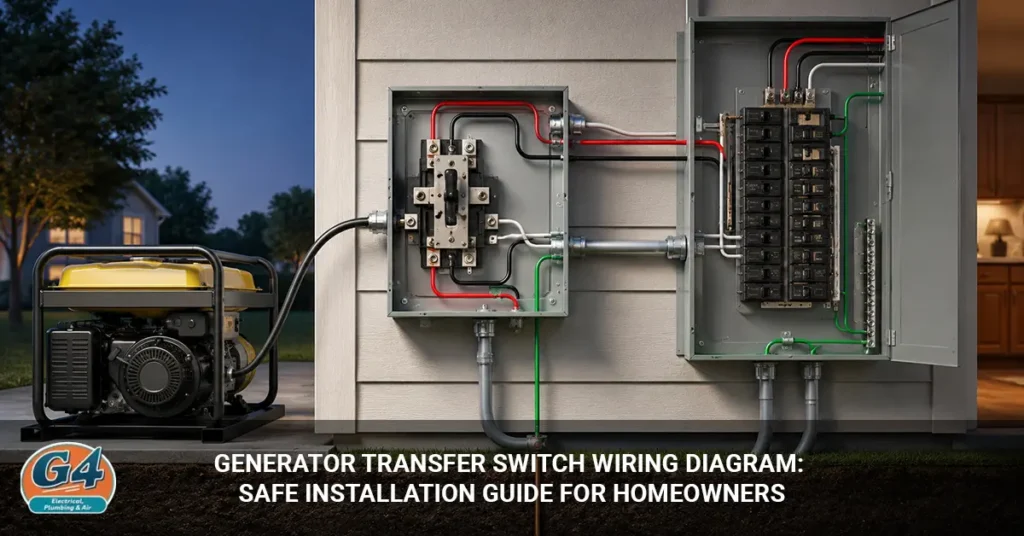
A generator transfer switch wiring diagram shows how a transfer switch safely connects a backup generator to your home’s electrical system. It ensures electricity comes from either the utility company or the generator, but never both at the same time.
If you use a portable or standby generator, a transfer switch is one of the most important safety components in the entire system. It prevents dangerous backfeeding, protects electrical equipment, and helps keep your home safe during power outages.
Many homeowners know they need a generator during emergencies, but few understand how the transfer switch makes the system work safely. Learning the basics can help you understand your backup power setup, recognize key components, and make better decisions about installation and maintenance.
In this guide, you’ll learn how generator transfer switches work, how to read a transfer switch wiring diagram, the different types of transfer switches available, common installation mistakes, and important safety considerations every homeowner should know.
What Is a Generator Transfer Switch?
A generator transfer switch is a safety device that switches your home’s electrical supply between utility power and a backup generator. It allows only one power source to supply electricity at a time, preventing dangerous electrical conditions during a power outage.
Under normal circumstances, your home receives power from the utility company. When an outage occurs, the transfer switch disconnects utility power and safely connects generator power to selected circuits or, in some cases, the entire home.
Without a transfer switch, a generator should never be connected directly to a home’s electrical system because it can create serious safety hazards.
Why Transfer Switches Are Important
Transfer switches are important because they make generator operation safe, reliable, and code-compliant. They help protect your home, your electrical equipment, and the utility workers restoring power after an outage.
Some of the biggest benefits include:
- Prevent dangerous backfeeding
- Protect appliances and electronics
- Improve electrical safety
- Simplify generator operation
- Help meet electrical code requirements
- Reduce the risk of electrical damage during outages
A properly installed transfer switch ensures electricity flows safely through the electrical system and only reaches the circuits intended to receive power.
How a Transfer Switch Protects Your Home
A transfer switch protects your home by completely separating utility power from generator power. This prevents electricity from flowing in the wrong direction and protects both the electrical system and connected equipment.
Think of a transfer switch as a traffic controller for electricity. It directs power from either the utility company or the generator, but it never allows both sources to supply power at the same time.
This protection helps:
- Prevent damage to appliances and electronics
- Reduce electrical shock hazards
- Maintain stable power distribution
- Protect the electrical panel during outages
- Improve overall system safety
Because the transfer switch controls how backup power enters the home, it is one of the most important components in any generator installation.
What Happens Without a Transfer Switch?
Using a generator without a transfer switch can create serious electrical and safety risks. The most dangerous problem is backfeeding, which occurs when generator power travels into utility lines instead of remaining inside the home’s electrical system.
Backfeeding can:
- Create dangerous shock hazards
- Damage generators and electrical equipment
- Violate local electrical codes
- Increase the risk of electrical fires
- Endanger utility workers repairing power lines
Improper generator connections can also overload circuits, damage sensitive electronics, and create unstable voltage conditions throughout the home.
For these reasons, transfer switches are considered an essential part of a safe backup power system and are often required by electrical codes and local regulations.
How a Generator Transfer Switch Works
A generator transfer switch works by disconnecting utility power before connecting generator power to your home’s electrical system. This ensures that electricity comes from only one source at a time, preventing dangerous backfeeding and protecting both the home and the utility grid.
When utility power is available, the transfer switch keeps the generator isolated from the electrical system. When a power outage occurs, the switch safely transfers power from the utility company to the generator.
Utility Power Mode
During normal operation, your home receives electricity from the utility company.
In utility power mode:
- Utility power feeds the main electrical panel.
- Household circuits operate normally.
- The generator remains disconnected.
- The transfer switch stays in its normal position.
As long as utility power is available, the generator does not supply electricity to the home.
Generator Power Mode
During a power outage, the transfer switch changes the home’s power source from the utility grid to the generator.
In generator power mode:
- Utility power is disconnected.
- Generator power is connected to the electrical system.
- Selected circuits receive backup power.
- Essential appliances and equipment continue operating.
Depending on the system design, the generator may power a few critical circuits or the entire home.
Power Transfer Process
The transfer process follows a specific sequence to keep the electrical system safe.
A typical transfer occurs as follows:
- Utility power fails.
- The transfer switch disconnects utility power.
- The generator starts automatically or is manually connected.
- Generator power is routed to the selected circuits.
- The home operates on generator power during the outage.
- Utility power is restored.
- The transfer switch reconnects utility power.
- Generator power is disconnected.
- The generator shuts down or returns to standby mode.
This process prevents interruptions and ensures the electrical system remains protected throughout the outage.
Backfeed Prevention Explained
Backfeed prevention is one of the most important functions of a transfer switch. It prevents generator power from flowing into utility lines where it can create dangerous conditions.
Without a transfer switch, electricity from the generator could travel backward through the electrical system and energize power lines that utility workers expect to be de-energized.
Transfer switches prevent backfeeding by:
- Physically separating utility power and generator power
- Blocking both power sources from connecting simultaneously
- Controlling the direction of electrical flow
- Protecting the home’s electrical equipment
Because of this critical safety function, transfer switches are required for most generator installations and are considered an essential part of a safe backup power system.
Types of Generator Transfer Switches
Generator transfer switches are available in several types, each designed for different generator systems, budgets, and backup power needs. The best choice depends on how much automation you want and how many circuits you need to power during an outage.
Understanding the differences can help you choose the right transfer switch for your home.
Manual Transfer Switch
A manual transfer switch requires the homeowner to physically switch from utility power to generator power during an outage. It is one of the most common and affordable options for homes with portable generators.
Advantages include:
- Lower installation costs
- Simple design
- Reliable operation
- Minimal maintenance requirements
- Compatible with many portable generators
Limitations include:
- Requires manual operation
- Cannot switch power automatically
- Slower power restoration during outages
Manual transfer switches are often a practical choice for homeowners who only experience occasional power outages and do not mind starting and connecting the generator themselves.
Automatic Transfer Switch (ATS)
An automatic transfer switch, commonly called an ATS, automatically detects a power outage and transfers electrical loads to the generator without homeowner intervention.
When utility power fails, the ATS signals the standby generator to start and automatically switches the home’s power source. Once utility power returns, the system transfers power back to the grid and shuts down the generator.
Benefits include:
- Fully automatic operation
- Faster response during outages
- Greater convenience
- Reduced downtime
- Seamless backup power
Automatic transfer switches are most commonly paired with standby generators and are ideal for homeowners who want uninterrupted power during outages.
Whole-House Transfer Switch
A whole-house transfer switch allows a generator to power nearly all circuits in the home. These systems are typically used with larger standby generators capable of supporting significant electrical loads.
Whole-house systems are popular for:
- Larger homes
- Homes in areas with frequent outages
- Properties with critical electrical needs
- Homeowners seeking complete backup power
Because these systems support more circuits, they generally require larger generators and a greater installation investment.
Essential-Circuit Transfer Switch
An essential-circuit transfer switch powers only selected circuits that are considered most important during an outage. This approach reduces generator load requirements and allows smaller generators to provide meaningful backup power.
Commonly protected circuits include:
- Refrigerators and freezers
- Lighting circuits
- Heating and cooling equipment
- Medical devices
- Internet and communication equipment
- Sump pumps
- Security systems
Because only critical circuits receive power, essential-circuit transfer switches are often a cost-effective solution for homeowners who want reliable backup power without investing in a whole-house generator system.
Choosing the right transfer switch depends on your generator size, budget, and backup power goals. For many homeowners, an essential-circuit or manual transfer switch provides sufficient protection, while larger homes often benefit from an automatic whole-house system.
Generator Transfer Switch Wiring Diagram Explained
A generator transfer switch wiring diagram shows how utility power, generator power, and household circuits are connected through the transfer switch. Understanding the diagram helps homeowners identify the major components in the system and understand how electricity flows during normal operation and power outages.
While transfer switch diagrams may look complicated at first, they become much easier to understand once you learn the basic components and symbols used throughout the system.
Main Components in the Diagram
Most generator transfer switch wiring diagrams include several key components that work together to safely distribute power.
Common components include:
- Utility power source: Supplies electricity from the power company during normal operation.
- Generator connection: Provides backup power during an outage.
- Transfer switch: Safely switches power between utility and generator sources.
- Main electrical panel: Distributes power to household circuits.
- Circuit breakers: Protect circuits from overloads and short circuits.
- Grounding conductors: Provide protection against electrical faults.
- Neutral conductors: Complete the electrical circuit and provide a return path for current.
Each component plays an important role in ensuring safe and reliable operation of the backup power system.
Understanding Wire Labels and Symbols
Transfer switch diagrams use labels and symbols to identify electrical components and wiring connections. Learning these symbols makes diagrams much easier to read and troubleshoot.
Common labels and symbols include:
- Line conductors (Hot wires): Carry electrical power from the utility company or generator.
- Neutral conductors: Return current back to the power source.
- Ground conductors: Provide a safe path for fault current.
- Circuit breakers: Protect circuits from excessive current.
- Transfer contacts: Control switching between power sources.
- Generator inputs: Show where backup power enters the system.
Although symbol styles can vary between manufacturers, their purpose is generally the same across most wiring diagrams.
Reading a Transfer Switch Diagram Step by Step
The easiest way to understand a transfer switch wiring diagram is to follow the flow of electricity through the system.
Start with these steps:
- Locate the utility power source.
- Identify the transfer switch.
- Locate the generator connection.
- Follow the power path to the main electrical panel.
- Identify the circuits protected by the generator.
- Verify neutral and grounding connections.
By tracing the power path from source to load, you can quickly understand how the system operates during normal conditions and power outages.
Common Diagram Variations
Transfer switch wiring diagrams vary depending on the type of generator system being installed. Different systems require different wiring layouts and components.
Common diagram types include:
- Portable generator systems
- Standby generator systems
- Whole-house transfer switch systems
- Essential-load transfer switch systems
- Manual transfer switch configurations
- Automatic transfer switch (ATS) configurations
Because wiring requirements vary by manufacturer and model, always refer to the installation diagram provided with your specific transfer switch and generator. Using the correct diagram helps ensure safe installation, proper operation, and compliance with local electrical codes.
Safety Precautions Before Wiring a Transfer Switch
Transfer switch installation involves high-voltage electrical work and should always be performed with safety as the top priority. Even a small wiring mistake can lead to electrical shock, equipment damage, fire hazards, or code violations.
Before working on a transfer switch or any part of the electrical system, take the following precautions.
Turn Off Main Power
Always turn off the main power supply before working on electrical equipment. This helps prevent accidental contact with energized conductors and reduces the risk of electrical shock.
Before beginning any work:
- Shut off the main breaker.
- Follow proper lockout procedures when applicable.
- Ensure no one restores power while work is being performed.
Never assume a circuit is safe simply because a switch has been turned off.
Verify Circuits Are De-Energized
Always test electrical conductors before touching them. A circuit may still be energized even after the breaker has been switched off.
Use an approved voltage tester to:
- Confirm power is disconnected.
- Check incoming utility conductors.
- Verify generator circuits are not energized.
- Test multiple points within the system.
Testing before touching any wiring is one of the most important electrical safety practices.
Use Proper Safety Equipment
Using the correct protective equipment helps reduce the risk of injury while working around electrical systems.
Recommended safety equipment includes:
- Safety glasses
- Insulated gloves
- Electrical-rated hand tools
- Non-conductive footwear
- Flashlight or work light
Proper personal protective equipment (PPE) provides an extra layer of protection when working near electrical components.
Follow Local Electrical Codes
Transfer switch installations must comply with local electrical and building codes. These requirements are designed to ensure safe operation and protect both people and property.
Code requirements may cover:
- Transfer switch selection
- Wiring methods
- Grounding and bonding
- Generator connections
- Permit and inspection requirements
Failure to follow code requirements can create safety hazards and may result in failed inspections or insurance issues.
Understand Generator Capacity Limits
A generator must be properly sized for the electrical load it is expected to power. Connecting more equipment than the generator can handle may lead to poor performance, overheating, or equipment damage.
Before connecting circuits, consider:
- Generator wattage rating
- Starting and running loads
- Essential versus non-essential circuits
- Future power requirements
Proper load planning helps ensure reliable operation and prevents unnecessary strain on the generator.
Know When to Call a Licensed Electrician
Transfer switch installation often involves electrical panel modifications and code compliance requirements. If you are unsure about any aspect of the installation, contact a licensed electrician.
Professional assistance is especially important when:
- Installing a new transfer switch
- Modifying the main electrical panel
- Working with whole-house generator systems
- Troubleshooting wiring problems
- Meeting permit or inspection requirements
When it comes to generator wiring, safety should always come before convenience. A properly installed transfer switch protects your home, your generator, and everyone who depends on the system during a power outage.
Common Generator Transfer Switch Problems
Generator transfer switches are generally reliable, but they can occasionally develop problems that prevent backup power from operating correctly. Identifying the cause quickly can help restore power and prevent damage to the generator or electrical system.
Below are some of the most common transfer switch issues homeowners encounter.
Generator Power Not Reaching Circuits
If the generator is running but household circuits are not receiving power, there may be a problem with the transfer switch, wiring, or generator output.
Common causes include:
- Loose or damaged wiring
- Tripped circuit breakers
- Faulty transfer switch components
- Generator output problems
- Improper transfer switch settings
Start by checking the generator, breakers, and transfer switch connections. If the issue persists, professional diagnosis may be required.
Transfer Switch Not Switching Properly
A transfer switch that fails to transfer power can leave the home without backup electricity during an outage.
Common causes include:
- Worn electrical contacts
- Mechanical component failure
- Faulty control circuits
- Damaged relays
- Lack of routine maintenance
Automatic transfer switches may also fail to switch if communication with the generator is interrupted.
Generator Fails to Start
If the generator does not start during an outage, the transfer switch cannot provide backup power.
Possible causes include:
- Low fuel levels
- Dead or weak battery
- Faulty starter components
- Control system failures
- Poor maintenance
Regular generator inspections and maintenance can help prevent many startup problems.
Tripped Breakers
A tripped breaker is a common issue that can interrupt power flow between the generator and connected circuits.
Breakers may trip because of:
- Overloaded circuits
- Short circuits
- Ground faults
- Damaged wiring
- Faulty electrical equipment
Repeated breaker trips should never be ignored because they often indicate an underlying electrical problem that needs correction.
ATS Communication Errors
Automatic Transfer Switches (ATS) rely on communication between the generator and the transfer switch to operate properly. If communication is lost, the system may fail to transfer power automatically.
Common causes include:
- Damaged communication wiring
- Loose electrical connections
- Faulty control modules
- Software or programming issues
- Generator controller failures
Many modern standby generators display diagnostic codes that can help identify communication problems.
Signs Your Transfer Switch Needs Professional Service
Some transfer switch issues require immediate professional attention.
Watch for:
- Failure to transfer power during outages
- Burning smells
- Buzzing or crackling sounds
- Visible damage or discoloration
- Frequent breaker trips
- Error codes that continue to appear
If you notice any of these warning signs, contact a licensed electrician or generator service technician. Prompt repairs can help prevent larger electrical problems and ensure your backup power system is ready when you need it most.
When to Call a Licensed Electrician
A licensed electrician should be involved whenever generator wiring connects to the home’s electrical panel or transfer switch. Generator systems handle high-voltage electricity, and even small wiring mistakes can create serious safety hazards.
Professional assistance is especially important when installing a new generator system. Proper generator sizing, transfer switch selection, circuit planning, and code-compliant wiring all play a critical role in safe operation.
Whole-house transfer switch installations should also be handled by a qualified electrician. These systems connect directly to the main electrical service and must be designed to safely manage larger electrical loads during an outage.
If the project requires modifications to the main electrical panel, professional installation is strongly recommended. Working inside an electrical panel exposes you to energized components and requires a thorough understanding of electrical safety practices.
Code compliance is another reason to hire an electrician. Generator installations must often meet local electrical regulations, obtain permits, and pass inspections. A licensed professional can help ensure the system complies with all applicable requirements.
Professional troubleshooting is also valuable when a transfer switch fails to operate correctly. Problems such as failed power transfers, recurring breaker trips, generator communication errors, or unexplained power loss can be difficult to diagnose without the proper training and equipment.
Generator systems involve complex electrical connections, and improper installation can result in equipment damage, electrical shock, fire hazards, or unreliable backup power. If you’re unsure about any part of the installation or troubleshooting process, contacting a licensed electrician is the safest and most reliable option.
Frequently Asked Questions
Can I connect a generator without a transfer switch?
No, you should not connect a generator to your home’s electrical system without a transfer switch. A transfer switch prevents dangerous backfeeding, which can energize utility lines and create serious shock hazards. It also helps protect your electrical equipment and ensures the installation meets electrical code requirements.
Is a transfer switch required by code?
In many areas, a transfer switch or another approved transfer device is required for generator installations. Local electrical codes vary by location, so it’s important to check with your local building department or a licensed electrician before installing a generator system.
What size transfer switch do I need?
The correct transfer switch size depends on your generator’s output and the amount of electrical load you plan to power during an outage. A larger generator typically requires a larger transfer switch. An electrician can perform a load calculation to determine the right size for your specific setup.
What is the difference between a manual and automatic transfer switch?
A manual transfer switch requires you to physically switch power from the utility company to the generator during an outage. An automatic transfer switch detects a power outage, starts the generator, and transfers power automatically without any homeowner involvement.
Can a portable generator power an entire house?
Most portable generators are designed to power selected circuits rather than an entire home. They are commonly used to operate essential items such as refrigerators, lights, sump pumps, and heating equipment. Powering an entire house typically requires a larger standby generator and a properly sized transfer switch.
How often should a transfer switch be tested?
Most manufacturers recommend testing a transfer switch regularly to ensure it will operate properly during an outage. Many homeowners test their backup power system every month or follow the maintenance schedule provided by the generator manufacturer. Routine testing helps identify potential problems before an emergency occurs.
Final Thoughts
A generator transfer switch is an essential safety device that allows a generator to power your home safely during an outage. It separates utility power from generator power, prevents dangerous backfeeding, and helps keep your electrical system operating reliably when the grid goes down.
Understanding how a generator transfer switch works and how to read a wiring diagram can give homeowners a better understanding of their backup power system. It also makes it easier to identify major components, understand power flow, and communicate more effectively when maintenance or repairs are needed.
While learning the basics is helpful, transfer switch installation is not a project to take lightly. These systems connect directly to your home’s electrical infrastructure and must be installed correctly to ensure safety, reliability, and compliance with local electrical codes.
If you’re planning a new generator installation, upgrading an existing system, or troubleshooting transfer switch issues, consulting a licensed electrician is often the safest choice. Professional installation helps protect your home, your electrical equipment, and your family while ensuring your backup power system is ready when you need it most.